Other grades of this product :
| Lomustine Basic information |
| Lomustine Chemical Properties |
| Melting point | 88-90 | | Boiling point | 63.6°C (rough estimate) | | density | 1.3840 (rough estimate) | | refractive index | 1.5790 (estimate) | | storage temp. | 2-8°C | | solubility | Practically insoluble in water, freely soluble in acetone and in methylene chloride, soluble in ethanol (96 per cent). | | form | neat | | pka | 10.88±0.20(Predicted) | | color | Light orange to Yellow to Green | | Merck | 14,5564 | | InChIKey | GQYIWUVLTXOXAJ-UHFFFAOYSA-N | | CAS DataBase Reference | 13010-47-4(CAS DataBase Reference) | | IARC | 2A (Vol. 26, Sup 7) 1987 | | EPA Substance Registry System | 1-(2-Chloroethyl)-3-cyclohexyl-1-nitrosourea (13010-47-4) |
| Hazard Codes | T | | Risk Statements | 45-25 | | Safety Statements | 53-45 | | RIDADR | 3249 | | WGK Germany | 3 | | RTECS | YS4900000 | | HazardClass | 6.1(a) | | PackingGroup | II | | HS Code | 29299090 | | Hazardous Substances Data | 13010-47-4(Hazardous Substances Data) | | Toxicity | LD50 in male mice (mg/kg): 51 orally; 56 i.p.; 61 s.c. (Thompson, Larson) |
| Lomustine Usage And Synthesis |
| Chemical Properties | Lomustine is a pale yellow powder.
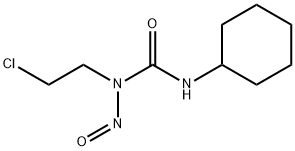
| | Uses | CCNU is an oral anticancer drug that was approved by the U.S. Food and Drug Administration in 1976 for marketing, as lomustine (FDA 2009a). CCNU is used alone or in combination with other antineoplastic agents, including procarbazine and vincristine, etoposide and prednimustine, and other combinations (IARC 1981, HSDB 2009). It is used primarily in the treatment of Hodgkin’s disease and brain tumors, but it has also been used to treat other cancer, includ-ing lung cancer, non-Hodgkin’s lymphoma, malignant melanoma, breast cancer, kidney cancer, and cancer of the gastrointestinal tract (MedlinePlus 2009). It has also been applied to the skin to treat mycosis fungoides and psoriasis. | | Uses | Lomustine USP is used to treat Malignant brain tumors; Hodgkin’s disease. | | Uses | Chloroethylnitrosourea derivative with antitumor activity. Similar to carmustine, chlorozotocin, nimustine, ranimustine. Antineoplastic. | | Definition | ChEBI: An N-nitrosourea that is urea in which one of the nitrogens is substituted by a 2-chloroethyl group and by a nitroso group, while the other nitrogen is substituted by a cyclohexyl group. An alkylating antineoplastic agent, it is used in
he treatment of brain tumours, lung cancer, malignant melanoma and other solid tumours. | | Brand name | Ceenu (Bristol-Myers
Squibb). | | Synthesis Reference(s) | Journal of Medicinal Chemistry, 18, p. 104, 1975 DOI: 10.1021/jm00235a023Synthesis, p. 1027, 1987 DOI: 10.1055/s-1987-28160 | | General Description | Lomustine is available in 10-, 40-, and 100-mg capsules fororal administration in the treatment of primary and metastaticbrain cancers and Hodgkin’s lymphoma. This lipophilicagent is well absorbed, widely distributed, and crosses theblood-brain barrier. Lomustine undergoes extensive hepaticmetabolism, which is mediated by CYP3A4 to give severalhydroxylated metabolites, which arise as a result of oxidationof the cyclohexyl ring. Several of these are more activethan the parent compound. Denitrosation and dechlorinationhave also been demonstrated to occur for lomustine as well.The intact drug was not found in plasma when the agent wasadministered orally. Elimination occurs primarily in theurine with an elimination half-life of 16 to 72 hours.Myelosuppression is dose limiting and presents in a mannersimilar to that seen with carmustine. Other toxicities includenausea, vomiting, anorexia, impotence, sterility, amenorrhea,and infertility. Pulmonary and renal toxicity are rarelyseen during standard-dose therapy but increase during highdosetherapy. | | Biological Activity | lomustine is an antineoplastic drug used in chemotherapy [1]lomustine has been revealed to inhibit the growth of tumour cell lines with ic50 values of 25μm, 8.8μm and 13μm for breast zr-75-1, astrocytoma u87mg and colorectal ls174t cell lines [2]. besides, lomustine has been found to be particularly effective in the treatment of certain neoplasms of the central nervous system, because of the high lipid solubility and permeability through the blood brain barrier. in addition, lomustine has shown the effect function in treatment of meningeal leukemia in the mouse and in children who have acute leukemia with central nervous system involvement [1]. | | Biochem/physiol Actions | Antineoplastic agent with cellular DNA effects. Lomustine induces p53 expression in A2870 cells. | | Mechanism of action | Like other nitrosoureas, lomustine acts as a DNA-alkylating agent, and it also inhibits various key enzymatic reactions by carbamoylating proteins. | | Clinical Use | #N/A | | Safety Profile | Confirmed carcinogen
with experimental carcinogenic and
tumorigenic data. Poison by ingestion,
intraperitoneal, subcutaneous, intravenous,
and possibly other routes. Human systemic
effects by ingestion: anorexia, nausea or
vomiting, leukopenia (decrease in the white
blood cell count), and thrombocytopenia
(decrease in the number of blood platelets).
Experimental teratogenic and reproductive
effects. Human mutation data reported.
When heated to decomposition it emits very
toxic fumes of Cland NOx. See also NNITROSO COMPOUNDS. | | Synthesis | Lomustine, 1-(2-chloroethyl)-3-cyclohexyl-1-nitrosourea (30.2.4.3), is made
by reacting ethanolamine with cyclohexylisocyanate, which forms 1-(2-hydroxyethyl)-3-
cyclohexylurea (30.2.4.1). Upon reaction with thionyl chloride, the hydroxyl group in it is
replaced with a chlorine atom, giving 1-(2-chloroethyl)-3-cyclohexylurea (30.2.4.2). This
is nitrated in non-aqueous conditions with formic acid and sodium nitrite to give lomustine (30.2.4.3). | | Potential Exposure | A potential danger to those involved
in the manufacture, administration or consumption of this
antineoplastic (anti-cancer) agent | | Veterinary Drugs and Treatments | Lomustine may be useful in the adjunctive treatment of CNS neoplasms,
lymphomas, and mast cell tumors in dogs and cats. | | Carcinogenicity | 1-(2-Chloroethyl)-3-cyclohexyl-1-nitrosourea (CCNU) is reasonably
anticipated to be a human carcinogen based on sufficient evidence of carcinogenicity from studies in experimental animals. | | Metabolism | Molecular weight (daltons) 233.7
% Protein binding 60
% Excreted unchanged in urine 50 (as metabolites)
Volume of distribution (L/kg) No data
Half-life - normal/ESRF (hrs) 16-48 (metabolites) | | Shipping | UN2811 Toxic solids, organic, n.o.s., Hazard
Class: 6.1; Labels: 6.1-Poisonous materials, Technical
Name Required. UN3249 Medicine, solid, toxic, n.o.s.,
Hazard Class: 6.1; Labels: 6.1-Poisonous materials | | Waste Disposal | It is inappropriate and possibly
dangerous to the environment to dispose of expired or waste
drugs and pharmaceuticals by flushing them down the toilet
or discarding them to the trash. Household quantities of
expired or waste pharmaceuticals may be mixed with wet
cat litter or coffee grounds, double-bagged in plastic, discard
in trash. Larger quantities shall carefully take into consideration applicable DEA, EPA, and FDA regulations. If possible return the pharmaceutical to the manufacturer for proper
disposal being careful to properly label and securely package
the material. Alternatively, the waste pharmaceutical shall be
labeled, securely packaged and transported by a state
licensed medical waste contractor to dispose by burial in a
licensed hazardous or toxic waste landfill or incinerator. | | references | [1] cheng cj, fujimura s, grunberger d, weinstein ib. nteraction of 1-(2-chloroethyl)-3-cyclohexyl-1-nitrosourea (nsc 79037) with nucleic acids and proteins in vivo and in vitro. cancer res. 1972 jan;32(1):22-7.[2] baer jc1, freeman aa, newlands es, watson aj, rafferty ja, margison gp. depletion of o6-alkylguanine-dna alkyltransferase correlates with potentiation of temozolomide and ccnu toxicity in human tumour cells.br j cancer. 1993 jun; 67(6):1299-302. |
| Lomustine Preparation Products And Raw materials |
|


 日本语
日本语 한국어
한국어 Français
 Deutsch
 España
 Türkiye