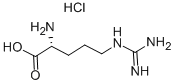
| D-(-)-Arginine hydrochloride Basic information |
| Product Name: | D-(-)-Arginine hydrochloride |
| Synonyms: | monohydrochloride,d-arginin;H-D-ARG-OH HCL;D-2-AMINO-5-GUANIDINOVALERIC ACID HYDROCHLORIDE;D-ARGININE HCL;D(-)-ARGININE HYDROCHLORIDE;D-ARGININE HYDROCHLORIDE;D-ARGININE MONOHYDROCHLORIDE;D-Arginine.monohydrchloride |
| CAS: | 627-75-8 |
| MF: | C6H15ClN4O2 |
| MW: | 210.66 |
| EINECS: | 211-010-1 |
| Product Categories: | Peptide Synthesis;AMINO ACIDS;Arginine Metabolism;ArginineNitric Oxide and Cell Stress;Amino Acid Derivatives;Nitric Oxide Metabolism |
| Mol File: | 627-75-8.mol |
| D-(-)-Arginine hydrochloride Chemical Properties |
| Melting point | 216-218 °C(lit.) |
| alpha | -21 º (c=3.5 1 N HCl) |
| storage temp. | Inert atmosphere,Room Temperature |
| Water Solubility | Soluble in water (50 mg/ml), and 3N HCl (5). |
| BRN | 5773432 |
| InChIKey | KWTQSFXGGICVPE-PGMHMLKASA-N |
| CAS DataBase Reference | 627-75-8(CAS DataBase Reference) |
| NIST Chemistry Reference | Arginine hydrochloride(L)(627-75-8) |
| EPA Substance Registry System | D-Arginine, monohydrochloride (627-75-8) |
| Safety Information |
| Risk Statements | 20/22 |
| Safety Statements | 22-24/25 |
| WGK Germany | 3 |
| RTECS | CF1995000 |
| TSCA | Yes |
| HS Code | 29252900 |
| Toxicity | LD50 ipr-rat: 3582 mg/kg ABBIA4 64,319,56 |
| MSDS Information |
| Provider | Language |
|---|---|
| D-(-)-Arginine hydrochloride | English |
| ACROS | English |
| SigmaAldrich | English |
| ALFA | English |
| D-(-)-Arginine hydrochloride Usage And Synthesis |
| Chemical Properties | WHITE CRYSTALLINE POWDER |
| Uses | The influence in creatinine metabolismis that by that d-arginine monohydrochloride caused slightly larger increases in muscle creatine. D-Arginyl ethyl ester was synthesized by vigorously stirring D-arginine monohydrochloride and excess anhydrous ethanol in an ice bath. |
| Uses | D-arginine attenuates increased arginase expression, oxidative stress, endothelial dysfunction, and advanced glycation endproducts formation induced by methylgloxyl and high glucose. This attenuation by D-arginine is thought to occur through an endothelial NOS independent mechanism. |
| Safety Profile | Moderately toxic byintraperitoneal route. When heated to decomposition itemits toxic vapors of NOx, HCl, and Cl-. |
| D-(-)-Arginine hydrochloride Preparation Products And Raw materials |
Please leave a message for us or use the following ways to contact us, we will reply to you as soon as possible, and provide you with the most sincere service, thank you.


 日本语
日本语 한국어
한국어 Français
 Deutsch
 España
 Türkiye