Other grades of this product :
| Methyl cinnamate Chemical Properties |
| Safety Statements | 22-24/25 | | WGK Germany | 1 | | RTECS | GE0190000 | | TSCA | Yes | | HS Code | 29163990 | | Toxicity | Moderately toxic by ingestion . The oral LD50 for rats is 2610 mg / kg . It is combustible as a liquid, and when heated to decomposition it emits acrid smoke and irritating fumes. |
| Methyl cinnamate Usage And Synthesis |
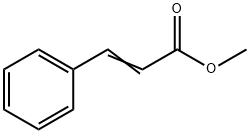
| Chemical Properties | Methyl cinnamate appears as white to slightly yellow crystals with a cherry and balsamic aroma. Melting point 34 ℃. The boiling point is 260°C, and the refractive index (nD20) is 1.5670. Relative density (d435) 1.0700. Soluble in alcohol, ether, glycerin, propylene glycol, most non-volatile oils and mineral oils, insoluble in water.Natural products are contained in basil oil (up to 52%), galangal oil and bay leaf oil. | | Preparative Methods | It is obtained by esterification of cinnamic acid with methanol. The mixture of cinnamic acid, methanol and sulfuric acid (or hydrochloric acid) was heated to reflux for 5 h, and the excess amount of methanol was added. Cool and spate the acid layer, washed with water and 10% sodium carbonate solution, and then washed with water to neutral. The crude product was subjected to recrystallization or vacuum distillation [collection of 132-134 ° C (2.0 kPa) fraction] to give methyl cinnamate with a yield of about 70%.
| | Description | Methyl cinnamate is the methyl ester of cinnamic acid and is a white or transparent solid with a strong, aromatic odor. It is found naturally in a variety of plants, including in fruits, like strawberry, and some culinary spices, such as Sichuan pepper and some varieties of basil. Eucalyptus olida has the highest known concentrations of methyl cinnamate (98 %) with a 2 - 6 % fresh weight yield in the leaf and twigs. Methyl cinnamate is used in the flavor and perfume industries. The flavor is fruity and strawberry-like; and the odor is sweet, balsamic with fruity odor, reminiscent of cinnamon and strawberry. It is known to attract males of various orchid bees, such as Aglae caerulea. Methyl cinnamate crystals extracted using steam distillation from Eucalyptus olida. | | Chemical Properties | Methyl cinnamate has a fruity, balsamic odor similar to strawberry and a corresponding sweet taste. | | Occurrence | Reported found in the oil from rhizomes of Alpinia malaccensis, in the oil from leaves of Ocimum canum
Sims.; in the oil of Narcissus jonquilla L.; in the oil from rhizomes of Gastrochilus panduratum Ridl.; two isomers (cis- and trans-)
exist in natural. Also reported found in cranberry, guava, pineapple, strawberry fruit and jam, cinnamon leaf, Camembert cheeses,
cocoa, avocado, plum, prune, cloudberry, starfruit, plum brandy, rhubarb, beli (Aegle marmelos Correa), loquat and Bourbon vanilla. | | Uses | Methyl cinnamate is used as a fragrance ingredient in cosmetics
and household products. | | Uses | Methyl cinnamate was used to inhibit monophenolase and diphenolase activity of mushroom tyrosinase and it also has antimicrobial ability. It is mainly is used in the flavor and perfume industries. It is known to attract males of various orchid bees, such as Aglae caerulea. | | Preparation | Methyl cinnamate is synthesized by esterification of cinnamic acid with methanol using HCl as catalyst, or by adding HCl to a boiling solution of cinnamyl nitrile in methanol. | | Synthesis Reference(s) | Journal of the American Chemical Society, 96, p. 1133, 1974 DOI: 10.1021/ja00811a029Tetrahedron Letters, 29, p. 6119, 1988 DOI: 10.1016/S0040-4039(00)82281-9 | | General Description | Methyl cinnamate is an important flavoring agent and fragrance ingredient. It is one of the main aroma components of basil oil, Japanese and Korean matsutake mushrooms. | | Flammability and Explosibility | Nonflammable | | Safety Profile | Moderately toxic by
ingestion. Combustible liquid. When heated
to decomposition it emits acrid smoke and
irritating fumes. |
| Methyl cinnamate Preparation Products And Raw materials |
|


 日本语
日本语 한국어
한국어 Français
 Deutsch
 España
 Türkiye