Other grades of this product :
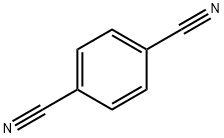
| 1,4-Dicyanobenzene Basic information |
| 1,4-Dicyanobenzene Chemical Properties |
| Melting point | 221-225 °C (lit.) | | Boiling point | 227.54°C (rough estimate) | | density | 1.3g/cm3(25℃) | | vapor density | 4.42 | | refractive index | 1.6231 (estimate) | | storage temp. | Sealed in dry,Room Temperature | | solubility | Chloroform (Slightly), DMSO (Slightly) | | form | Powder | | color | White to light yellow | | Water Solubility | 0.08 g/L (23 ºC) | | BRN | 1072210 | | Exposure limits | NIOSH: IDLH 25 mg/m3 | | Stability: | Stable. Incompatible with strong acids, strong bases, strong oxidizing agents, strong reducing agents. | | CAS DataBase Reference | 623-26-7(CAS DataBase Reference) | | NIST Chemistry Reference | 1,4-Benzenedicarbonitrile(623-26-7) | | EPA Substance Registry System | 1,4-Benzenedicarbonitrile (623-26-7) |
| Hazard Codes | Xi | | Risk Statements | 36/37/38 | | Safety Statements | 26-24/25 | | RIDADR | 3439 | | WGK Germany | 2 | | RTECS | CZ1925000 | | TSCA | Yes | | HazardClass | 6.1(b) | | PackingGroup | III | | HS Code | 29269095 | | Toxicity | LD50 orl-rat: >6400 mg/kg ZAARAM 19,225,69 |
| 1,4-Dicyanobenzene Usage And Synthesis |
| Chemical Properties | biege powder | | Uses | 1,4-dicyanobenzene as a new internal standard in utilizing solid-state infrared intensity methods for the determination of thiocyanate bonding. Used as photosensitizer in [2+2] cycloadditions, nitrile building block. | | Synthesis Reference(s) | The Journal of Organic Chemistry, 51, p. 4714, 1986 DOI: 10.1021/jo00374a041Tetrahedron Letters, 8, p. 759, 1967 | | Safety Profile | Moderately toxic by
ingestion and intraperitoneal routes. An eye
irritant. When heated to decomposition it
emits toxic fumes of CNand NO,. See also
NITRILES. | | Purification Methods | Crystallise the dinitrile from EtOH or AcOH, and has m 221.5-222.5o after sublimation. [Beilstein 9 H 846, 9 I 376, 9 II 613, 9 III 4255, 9 IV 3328.] |
| 1,4-Dicyanobenzene Preparation Products And Raw materials |
|


 日本语
 한국어
 Français
 Deutsch
 España
 Türkiye