Other grades of this product :
| Indole-3-carbinol Basic information |
| Indole-3-carbinol Chemical Properties |
| Melting point | 96-99 °C (lit.) | | Boiling point | 267.28°C (rough estimate) | | density | 1.1135 (rough estimate) | | refractive index | 1.5670 (estimate) | | storage temp. | 2-8°C | | solubility | soluble in Methanol | | pka | 15.10±0.10(Predicted) | | form | Crystalline Powder or Flakes | | color | Off-white to yellow-orange | | BRN | 121323 | | Stability: | 2-80C | | InChIKey | IVYPNXXAYMYVSP-UHFFFAOYSA-N | | CAS DataBase Reference | 700-06-1(CAS DataBase Reference) |
| Hazard Codes | Xi | | Risk Statements | 36/38 | | Safety Statements | 26-36 | | WGK Germany | 3 | | RTECS | NL9483000 | | Hazard Note | Irritant | | HS Code | 29339900 |
| Indole-3-carbinol Usage And Synthesis |
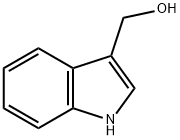
| Chemical Properties | Indole-3-carbinol is an off-white powder. It is soluble in organic solvents such as benzene, ethanol, DMSO, and dimethyl formamide (DMF), which should be purged with an inert gas. The solubility of Indole-3-carbinol in ethanol and DMF is approximately 10 mg/ml and approximately 3 mg/ml in DMSO. Indole-3-carbinol is an unstable compound that undergoes rapid oligomerization in acid pH environments, like the stomach. | | Occurrence | Indole-3-carbinol is produced by members of the family Cruciferae, and particularly members of the genus Brassica (e.g., cabbage, radishes, cauliflower, broccoli, Brussels sprouts, and daikon). | | Uses | Indole-3-carbinol has been used for encapsulation with poly-lactic-co-glycolic acid (PLGA), to study its in-vitro anti-cancerogenic effects on breast adenocarcinoma epithelial (MCF7), colon adenocarcinoma epithelial (Caco2), prostate carcinoma epithelial (PC3) cells. It has also been used as a cytochrome P4501A (CYP1A) inducer. | | Definition | ChEBI: Indole-3-carbinol is an indolyl alcohol carrying a hydroxymethyl group at position 3. It is a constituent of the cruciferous vegetables and had anticancer activity. | | Preparation | Using indole, phosphorus oxychloride and N,N-dimethylformamide as raw materials, indole-3-carbaldehyde was synthesized by Vilsmeier-Haack reaction with a yield of 87.1%. | | Application | Indole-3-carbinol (I3C) is a secondary plant metabolite of 3-methylindole produced in Brassica family vegetables. It is an inhibitor of Amyloid-beta deposition and Inhibits cancinogenesis at the initiation stage. Indole-3-carbinol is used in cancer prevention, specifically for breast, cervical and colon cancers. It has also been widely used to address lupus. | | Synthesis Reference(s) | Canadian Journal of Chemistry, 31, p. 775, 1953 DOI: 10.1139/v53-106The Journal of Organic Chemistry, 61, p. 1493, 1996 DOI: 10.1021/jo951219c | | General Description | Indole-3-carbinol is a novel secondary plant metabolite produced in cruciferous vegetables, such as cabbage, cauliflower and brussels sprouts. | | Biochem/physiol Actions | Inhibits cancinogenesis at the initiation stage. Has be shown to inhibit carcinogenesis in several animal species, but it enhances tumor incidence if administered at a post-initiation stage. Found in cruciferous vegetables. | | Anticancer Research | I3C is a bioactive compound majorly found in Brassica vegetables including broccoli,cauliflower, and collard greens. I3C and its derivative diindolylmethane (DIM)have been investigated for cancer prevention and treatment of breast, prostate, andovarian cancers. I3C partially modulates the tyrosine kinase/PI3K/Akt signalingpathway which leads to the prevention of lung adenocarcinoma which is induced byusing tobacco carcinogen in A/J mice. DIM transduces signaling via aryl hydrocarbon(Ah) receptor, NF-κB/Wnt/Akt/mTOR signaling pathways, cell cycle arrest,modulated cytochrome P450 enzymes, and altered angiogenetic and invasive,metastatic, and epigenetic behavior of cancer cells. Combination of DIM and I3Cinduces Nrf2-mediated phase II drug metabolizing genes (GSTm2, UGT1A1, andNQO1) and antioxidant genes (HO-1, SOD-1) (Weng et al. 2008; 2012). |
| Indole-3-carbinol Preparation Products And Raw materials |
|


 日本语
日本语 한국어
한국어 Français
 Deutsch
 España
 Türkiye