Other grades of this product :
| Glycopyrrolate Basic information |
| Glycopyrrolate Chemical Properties |
| Melting point | 192-195°C | | density | 1.3222 (rough estimate) | | refractive index | 1.6200 (estimate) | | storage temp. | 2-8°C | | solubility | H2O: ≥24mg/mL | | form | powder | | color | white to tan | | Merck | 14,4501 | | CAS DataBase Reference | 596-51-0(CAS DataBase Reference) |
| Hazard Codes | Xi | | Risk Statements | 36/37/38 | | Safety Statements | 26 | | WGK Germany | 3 | | RTECS | UY4337630 | | HS Code | 29339900 | | Toxicity | LD50 (72 hr.) in female mice, female rats (mg/kg): 107, 196 i.p.; in male rats (mg/kg): 1150 orally (Franko) |
| Glycopyrrolate Usage And Synthesis |
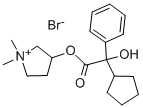
| Description | Glycopyrrolate is an antagonist of muscarinic acetylcholine receptors (mAChRs; Kis = 0.42, 1.77, 0.52, 0.78, and 1.29 nM for the M1-M5 receptors, respectively). It induces relaxation of precontracted isolated human bronchi when used at concentrations of 0.01, 0.1, or 1 μM. Glycopyrrolate reduces post-prandial gastric antral motility in dogs when administered at a dose of 0.01 mg/kg. It inhibits salivation in a rat model of sialorrhea induced by pilocarpine with an ED50 value of 0.74 μg/kg. Formulations containing glycopyrrolate have been used in the treatment of sialorrhea, peptic ulcers, and chronic obstructive pulmonary disease (COPD). | | Chemical Properties | White Solid | | Originator | Robinul,Robins,US,1961 | | Uses | Inhaled glycopyrrolate of is used to treat air flow blockage and prevent worsening of chronic obstructive pulmonary disease (COPD), including chronic bronchitis and emphysema. COPD is a long-term lung disease that causes bronchospasm (difficulty with breathing). | | Uses | sunscreen | | Uses | For use as a preoperative antimuscarinic to reduce salivary, tracheobronchial, and pharyngeal secretions, to reduce the volume and free acidity of gastric secretions and to block cardiac vagal inhibitory reflexes during induction of anesthesia and intubat | | Uses | A synthetic, quaternary ammonium anticholinergic. Antispasmodic; preanesthetic medicant. | | Definition | ChEBI: A quaternary ammonium salt composed of 3-{[cyclopentyl(hydroxy)phenylacetyl]oxy}-1,1-dimethylpyrrolidin-1-ium and bromide ions in a 1:1 ratio. | | Manufacturing Process | A mixture of 42.5 grams (0.17 mol) of methyl α-cyclopentyl mandelate and 18
grams (0.175 mol) of 1-methyl-3-pyrrolidinol in 500 ml of heptane was
refluxed under a Dean and Stark moisture trap, with the addition of four 0.1
gram pieces of sodium at 1-hour intervals. After 5 hours' refluxing the
solution was concentrated to one-half volume, and extracted with cold 3N HCl.
The acid extract was made alkaline with aqueous sodium hydroxide and
extracted with ether which was washed, dried over sodium sulfate, filtered
and concentrated. The residue was fractionated at reduced pressure. Yield 33
grams (64%); BP 151° to 154°C/0.2 mm, nD23= 1.5265.
The hydrochloride salt was precipitated as an oil from an ethereal solution of
the base with ethereal hydrogen chloride. It was crystallized from butanone;
MP 170° to 171.5°C.
The methyl bromide quaternary was prepared by saturating a solution of the
base in dry ethyl acetate with methyl bromide. After standing for 9 days the resulting crystalline solid was filtered and recrystallized from butanone and
from ethyl acetate; MP 193° to 194.5°C. | | Brand name | Robinul (Baxter Healthcare); Robinul (Sciele). | | Therapeutic Function | Spasmolytic | | General Description | Glycopyrrolate, 3-hydroxy-1,1-dimethylpyrrolidinium bromide -cyclopentylmandelate(Robinul), occurs as a white, crystalline powder that is solublein water or alcohol but practically insoluble in chloroformor ether.Glycopyrrolate is a typical anticholinergic and possesses,at adequate dosage levels, the atropine-like effectscharacteristic of this class of drugs. It has a spasmolyticeffect on the musculature of the GI tract as well as the genitourinarytract. It diminishes gastric and pancreatic secretionsand the quantity of perspiration and saliva. Its sideeffects are also typically atropine-like (i.e., dryness of themouth, urinary retention, blurred vision, constipation).Glycopyrrolate is a more potent antagonist on M1 than onM2 and M3 receptors. The low affinity of M2 receptorsmay, in part, explain the low incidence of tachycardiaduring use of this drug as an antispasmodic.77 Because ofits quaternary ammonium character, glycopyrrolate rarelycauses CNS disturbances, although in sufficiently highdosage, it can bring about ganglionic and myoneural junctionblock. | | Biochem/physiol Actions | Glycopyrrolate is long-acting muscarinic antagonist (LAMA). It is kinetically selective muscarinic M3 receptor antagonist. | | Mechanism of action | Glycopyrrolate exhibits onset of action within 1 minute when given intravenously and an elimination half-life of approximately 50 minutes. Glycopyrrolate undergoes urinary excretion and elimination. | | Clinical Use | Glycopyrrolate is used as an adjunct in the management of pepticulcer and other GI ailments associated with hyperacidity,hypermotility, and spasm. In common with other anticholinergics,its use does not preclude dietary restrictions or use ofantacids and sedatives if these are indicated. | | Side effects | - dry mouth
- blurred vision
- vision problems
- loss of taste
- headache
- nervousness
- confusion
- drowsiness
| | Safety Profile | Poison by intravenous
and intraperitoneal routes. Moderately toxic
by ingestion and subcutaneous routes.
Experimental reproductive effects. When
heated to decomposition it emits very toxic
fumes of NOx and Br-. See also BROMIDES. | | Veterinary Drugs and Treatments | Glycopyrrolate injection is approved for use in dogs and cats. The
FDA approved
indication for these species is as a preanesthetic anticholinergic
agent. The drug is also used to treat sinus bradycardia,
sinoatrial arrest, and incomplete AV block, where anticholinergic
therapy may be beneficial. When cholinergic agents such as neostigmine
or pyridostigmine are used to reverse neuromuscular
blockade
due to non-depolarizing muscle relaxants, glycopyrrolate may
be administered simultaneously
to prevent the peripheral muscarinic
effects of the cholinergic agent. |
| Glycopyrrolate Preparation Products And Raw materials |
|


 日本语
日本语 한국어
한국어 Français
 Deutsch
 España
 Türkiye