| Chemical Properties | Clear colorless to yellowish crystalline mass or liquid after meltin |
| Chemical Properties | Benzyl Cinnamate occurs in
balsams and balsam oils. It forms white, sweet-balsamic-smelling crystals (mp
35-36°C). Benzyl cinnamate is used as a fixative in perfumes and as a component
of heavy, oriental perfumes. |
| Chemical Properties | Benzyl cinnamate has a sweet, balsamic odor and a honey-like taste. |
| Occurrence | Reported found in Peru and Tolu balsam, in Sumatra and Penang benzoin, and as the main constituent of
copaiba balsam. |
| Uses | In artificial flavors, in perfumes, mainly as a fixative. |
| Uses | Benzyl cinnamate has been employed as internal standard during the determination of compounds commonly added to personal care products such as UV filters and antimicrobial agents in environmental samples. |
| Preparation | By heating benzyl chloride and excess sodium cinnamate in water to 100 to 115°C; by heating sodium cinnamate with an
excess of benzyl chloride in the presence of diethylamine. |
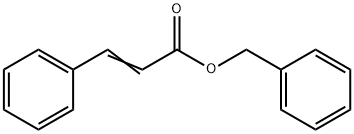
| Production Methods | Benzyl cinnamate is produced by the direct esterification of
benzyl alcohol with cinnamic acid. |
| Taste threshold values | Taste characteristics at 50 ppm: spicy, floral, fruity, balsamic. |
| General Description | Benzyl cinnamate is widely used as a fragrance ingredient. |
| Hazard | Moderately toxic. |
| Flammability and Explosibility | Nonflammable |
| Safety Profile | Moderately toxic by ingestion. Amild allergen and skin irritant. Combustible liquid. When heated to decomposition it emits acridsmoke and irritating fumes. |
| Metabolism | See monograph on Benzyl alcohol (p. 1011). |
| Purification Methods | Recrystallise the ester to a constant melting point from 95% EtOH. It has the odour of balsam. Alternatively dissolve it in Et2O, wash it with 10% aqueous Na2CO3, H2O, dry (Na2SO4), evaporate and fractionate it under reduced pressure using a short Vigreux column (p 11). It decomposes when boiled at atmospheric pressure. [Eliel & Anderson J Am Chem Soc 74 547 1952, Bender & Zerner J Am Chem Soc 84 2550 1962, Beilstein 9 IV 2012.] |


 日本语
日本语 한국어
한국어 Français
 Deutsch
 España
 Türkiye