Other grades of this product :
| 1,4-Dihydroxyanthraquinone Basic information |
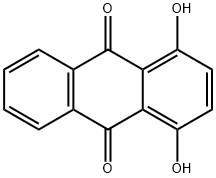
| Product Name: | 1,4-Dihydroxyanthraquinone | | Synonyms: | DSD ACID;CI NO 58050;CI 58050;LABOTEST-BB LT00052844;1,4-dihydroxy-10-anthracenedione;1,4-dihydroxy-9,10(9H,10H)anthracenedione;1,4-Dihydroxy-9,10-anthraquinone;1,4-Dihydroxyanthra-9,10-quinone | | CAS: | 81-64-1 | | MF: | C14H8O4 | | MW: | 240.21 | | EINECS: | 201-368-7 | | Product Categories: | Intermediates of Dyes and Pigments;Solvent Dyestuff;Anthraquinones, Hydroquinones and Quinones;Anthraquinones;Hydroxyanthraquinones;1 | | Mol File: | 81-64-1.mol |
| 1,4-Dihydroxyanthraquinone Chemical Properties |
| Melting point | 195-200 °C | | Boiling point | 450 °C | | density | 1.3032 (rough estimate) | | vapor density | 8.3 (vs air) | | vapor pressure | 1 mm Hg ( 196.7 °C) | | refractive index | 1.5430 (estimate) | | Fp | 222 °C | | storage temp. | Store below +30°C. | | solubility | <1g/l | | pka | pK (18°) 9.51 | | Colour Index | 58050 | | form | powder | | color | red-brown | | Water Solubility | <1 g/L (20 ºC) | | Merck | 14,8064 | | BRN | 1914036 | | InChIKey | GUEIZVNYDFNHJU-UHFFFAOYSA-N | | LogP | 4.2 at 25℃ | | CAS DataBase Reference | 81-64-1(CAS DataBase Reference) | | NIST Chemistry Reference | 9,10-Anthracenedione, 1,4-dihydroxy-(81-64-1) | | EPA Substance Registry System | Quinizarin (81-64-1) |
| 1,4-Dihydroxyanthraquinone Usage And Synthesis |
| Chemical Properties | orange to red-brown crystalline powder | | Uses | Antioxidant in synthetic lubricants, dyes.
| | Uses | 1,4-Dihydroxyanthraquinone, also known as quinizarin, is of great importance in manufacturing disperse, acid, and vat dyes. | | Uses | 1,4-Dihydroxyanthraquinone is used to color gasoline and some heating oils. It is used as an intermediate for the synthesis of indanthrene- and alizarin-derived dyes. It is also used to form lake pigments with calcium, barium and lead. It may be used in the synthesis of cyclopentanoids by cyclization of α,β-unsaturated aldehyde with 1, 4 1,4-Dihydroxyanthraquinone. It has been studied as a long range emissive ratiometric fluorescent probe for live cell imaging. | | Preparation | commonly known as Quinizarin. (a) Boric acid, boric acid and mercury, boric acid and nitrous acid or nitrous acid and mercury in the presence of Anthracene-9,10-dione with sulfuric acid; (b) In the presence of boric acid and nitrous acid, treated with sulfuric acid ?1-Hydroxyanthracene-9,10-dione or 2-Hydroxyanthracene-9,10-dione, (c)In the presence of boric acid, treated with sulfuric acid 1-Hydroxy-4-nitroanthracene-9,10-dione?or?1,4-Dichloroanthracene-9,10-dione?; (d) in the Boric acid and where did in the presence of sulfuric acid, Phthalic anhydride and 4-Chlorophenol?or Hydroquinone condensation, closed loop. | | Definition | ChEBI: A dihydroxyanthraquinone having the two hydroxy substituents at the 1- and 4-positions; formally derived from anthraquinone by replacement of two hydrogen atoms by hydroxy groups | | Synthesis Reference(s) | Synthesis, p. 633, 1974 DOI: 10.1055/s-1974-23387Tetrahedron Letters, 28, p. 1533, 1987 DOI: 10.1016/S0040-4039(01)81035-2 | | General Description | 1,4-Dihydroxyanthraquinone is an organic dye molecule with an aromatic structure. It is a derivative of anthraquinone bearing hydroxyl moieties. They may find uses in pharmacological, biochemical and dye industries. Anthraquinone dye are resistant to degradation. | | Flammability and Explosibility | Nonflammable | | Safety Profile | Poison by intravenous
route. Moderately toxic by intraperitoneal
route. Mutation data reported. An eye
irritant. A weak allergen. When heated todecomposition it emits acrid smoke and
irritating fumes. | | Purification Methods | Crystallise quinizarin from glacial acetic acid. [Beilstein 8 H 450, 8 IV 3260.] | | Properties and Applications | orange. Orange red powder. Insoluble in water, soluble in ether, in strong base in certain solubility, but soluble in organic solvent oil, etc. In concentrated sulfuric acid in green yellow fluorescence. Mainly used for oil coloring. Also used in all kinds of plastic and resin, light industry products coloring. |
| 1,4-Dihydroxyanthraquinone Preparation Products And Raw materials |
|


 日本语
 한국어
 Français
 Deutsch
 España
 Türkiye