Other grades of this product :
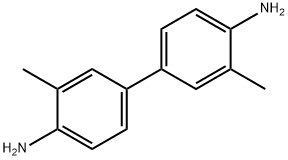
| Product Name: | O-Tolidine | | Synonyms: | 3,3'-Dimethyl-[1,1'-biphenyl]-4,4'-Diamine(O-Tolidine);1’-biphenyl)-4,4’-diamine,3,3’-dimethyl-(;1’-Biphenyl)-4,4’-diamine,3,3’-dimethyl-(1;1’-biphenyl)-4,4’-diamine-3,3’-dimethyl-(;1’-biphenyl]-4,4’-diamine,3,3’-dimethyl-[;2-Tolidin;2-Tolidina;2-Tolidine | | CAS: | 119-93-7 | | MF: | C14H16N2 | | MW: | 212.29 | | EINECS: | 204-358-0 | | Product Categories: | Organics;Intermediates of Dyes and Pigments;fine chemicals, specialty chemicals, intermediates, electronic chemical, organic synthesis;Building Blocks;Chemical Synthesis;Nitrogen Compounds;Organic Building Blocks;Polyamines | | Mol File: | 119-93-7.mol |
| O-Tolidine Chemical Properties |
| Melting point | 128-131 °C(lit.) | | Boiling point | 300.5 °C | | density | 0.9678 (rough estimate) | | refractive index | n20/D 1.341 | | Fp | 244 °C | | storage temp. | -20°C | | solubility | 2% HCl: 10 mg/mL, clear | | Colour Index | 37230 | | form | powder (may contain lumps) | | pka | 4.59±0.10(Predicted) | | color | light brown | | Water Solubility | Slightly soluble in water. | | Merck | 14,9514 | | BRN | 2210640 | | Exposure limits | TLV-TWA none; carcinogenicity: A2 — Suspected Human Carcinogen (ACGIH), Animal
Limited Evidence (IARC). | | InChIKey | NUIURNJTPRWVAP-UHFFFAOYSA-N | | IARC | 2B (Vol. 1, Sup 7) 1987 | | NIST Chemistry Reference | [1,1'-Biphenyl]-4,4'-diamine, 3,3'-dimethyl-(119-93-7) | | EPA Substance Registry System | 3,3'-Dimethylbenzidine (119-93-7) |
| O-Tolidine Usage And Synthesis |
| Description | 2-Tolidine (orthotolidine, o-tolidine; not to be confused with o-toluidine) is an organic compound with the chemical formula (C6H4(CH3)NH2)2. Several isomers are known; the 3-tolidine derivative is also important commercially. It is a colorless compound although commercial samples are often colored. It is slightly soluble in water. It forms salts with acids, such as the hydrochloride, which is commercially available. 2-Tolidine can be produced by a benzidine rearrangement from a hydrazine derivative derived from 2-nitrotoluene.
| | Uses | 2-Tolidine is a commercial aromatic amine used mainly for dye production. 2-Tolidine is an intermediate for the production of soluble azo dyes and insoluble pigments used particularly in the textile, leather and paper industries. 2-Tolidine was widely used as a reagent or indicator in analytical, clinical and forensic chemistry, such as in the analytical determination of gold, or determination of the chlorine level in swimming pool water. | | Chemical Properties | LIGHT GREY-GREEN TO GREY POWDER | | Chemical Properties | o-Tolidine is a white to reddish crystal or powder. Darkens on exposure to air. Often used in paste or wet cake form. Used as a basis for many dyes. | | Uses | o-Tolidine is used extensively in the manufacture of dyes. It is also used as a reagentfor the analysis of gold and free chlorine inwater. | | Uses | Sensitive colorimetric reagent for gold and for free chlorine in water. | | Uses | 3,3'-Dimethylbenzidine be used for preparation polyimide and epoxy resin material. | | Preparation | 1-Methyl-2-nitrobenzene?reduction for 3,3′-Dimethylbenzidine, and then b6-Amino-4-hydroxynaphthalene-2-sulfonic acid rearrangement of inversion. | | General Description | White to reddish crystals or crystalline powder or a light tan powder. | | Air & Water Reactions | Insoluble in water. | | Reactivity Profile | C.I. 37230 is sensitive to exposure to light. May be sensitive to prolonged exposure to air. A weak base that forms salts with hydrochloric acid or sulfuric acid. C.I. 37230 can be acetylated. Incompatible with strong agents . | | Hazard | Eye, bladder and kidney irritant, bladder
cancer, and methemoglobinemia. Possible carcinogen. | | Health Hazard | The information on toxicity and carcinogenicity of o-tolidine is very little. o-Tolidineoften contains other biphenylamine contaminants. Its structure and chemical propertiesare similar to those of benzidine. The toxicproperties are therefore expected to be similar to those of benzidine.o-Tolidine is absorbed into body throughthe skin, respiratory, and gastrointestinaltract. The acute oral and dermal toxicity wasmoderate in experimental animals. An oralLD50 value in rats is within the range of400 mg/kg.o-Tolidine produced bladder cancer in testspecies. Also, cancers in other tissues werenoted in some animals. ACGIH lists thissubstance as a suspected human carcinogen. | | Fire Hazard | Flash point data for C.I. 37230 are not available; however, C.I. 37230 is probably combustible. | | Safety Profile | Confirmed carcinogen
with experimental carcinogenic and
tumorigenic data. Poison by intraperitoneal
route. Moderately toxic by ingestion.
Human mutation data reported. When
heated to decomposition it emits toxic
fumes of NOx. | | Potential Exposure | Over 75% of o-tolidine is used as a dye and as an intermediate in the production of rubber products, dyestuffs, pigments and pesticides. Approximately 20% of o-tolidine is used in the production of polyurethane-based high-strength elastomers, coatings, and rigid plastics. o-Tolidine has also been used in small quantities in chlorine test kits by water companies and swimming pool owners. Used as a laboratory agent to detect blood. | | Carcinogenicity | 3,3′-Dimethylbenzidine is reasonably anticipated to be a human carcinogen based on sufficient evidence of carcinogenicity from studies in experimental animals. | | Shipping | UN2811 Toxic solids, organic, n.o.s., Hazard Class: 6.1; Labels: 6.1-Poisonous materials, Technical Name Required. UN3077 Environmentally hazardous substances, solid, n.o.s., Hazard class: 9; Labels: 9-Miscellaneous hazardous material, Technical Name Required. | | Purification Methods | Dissolve the tolidine in *benzene by percolation through a column of activated alumina and crystallise it from *benzene/pet ether. [Beilstein 13 IV 410.] | | Incompatibilities | Incompatible with oxidizers (chlorates, nitrates, peroxides, permanganates, perchlorates, chlorine, bromine, fluorine, etc.); contact may cause fires or explosions. Keep away from alkaline materials, strong bases, strong acids, oxoacids, epoxides, strong reducing agents. | | Waste Disposal | Dissolve in flammable solvent and spray into firebox of an incinera tor equipped with afterburner and scrubber. Consult with environmental regulatory agencies for guidance on acceptable disposal practices. Generators of waste containing this contaminant (≥100 kg/mo) must conform with EPA regulations governing storage, transportation, treatment, and waste disposal. |
| O-Tolidine Preparation Products And Raw materials |
| Raw materials | 2-Nitrotoluene-->6-Amino-4-hydroxy-2-naphthalenesulfonic acid-->O-Tolidine | | Preparation Products | disodium 3-[[4'-[(6-amino-1-hydroxy-3-sulphonato-2-naphthyl)azo]-3,3'-dimethoxy[1,1'-biphenyl]-4-yl]azo]-4-hydroxynaphthalene-1-sulphonate-->N,N'-(3,3'-Dimethyl-4,4'-biphenyldiyl)bis(3-oxobutanamide)-->DIRECT BLUE 15-->Sieber Linker-->ACID RED 114-->5-Amino-4-hydroxy-3-[[4'-[(1-hydroxy-4-sulfonaphthalen-2-yl)azo]-3,3'-dimethyl[1,1'-biphenyl]-4-yl]azo]-2,7-naphthalenedisulfonic acid trisodium salt-->N,N'-(3,3'-Dimethyl-4,4'-biphenyldiyl)bis(3-oxobutanamide)-->1,3,6-Naphthalenetrisulfonic acid, 8-hydroxy-7-[[4'-[(2-hydroxy-1-naphthalenyl)azo]-3,3'-dimethyl[1,1'-biphenyl]-4-yl]azo]-, trisodium salt-->BRILLIANT PURPURIN R-->trisodium 5-amino-3-[[4'-[(6-amino-1-hydroxy-3-sulphonato-2-naphthyl)azo]-3,3'-dimethyl[1,1'-biphenyl]-4-yl]azo]-4-hydroxynaphthalene-2,7-disulphonate-->Direct Black 24-->DIRECT ORANGE 6-->Direct Blue 53-->N,N'-(3,3'-dimethyl[1,1'-biphenyl]-4,4'-diyl)bis(3-hydroxynaphthalene-2-carboxamide)-->Direct Black 154-->Direct Brown 222-->C.I. Direct Orange 31-->OXAMINE BLUE 4R-->Direct Brown 146-->DIRECT YELLOW 2 |
|


 日本语
日本语 한국어
한국어 Français
 Deutsch
 España
 Türkiye