Other grades of this product :
| Duloxetine Basic information |
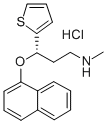
| Product Name: | Duloxetine | | Synonyms: | DULOXETINE;DULOXETINE-D3;(S)-DULOXETINE;DULOXETIN;(3S)-N-methyl-3-naphthalen-1-yloxy-3-thiophen-2-yl-propan-1-amine;N-Methyl-gama-(1-naphthalenyloxy)-2-thiophenepropanamine;DULOXETINE HCI;Duloxetine & Intermediates | | CAS: | 116539-59-4 | | MF: | C18H19NOS | | MW: | 297.41 | | EINECS: | 601-438-0 | | Product Categories: | API;ACTIVE PHARMACEUTICAL INGREDIENTS | | Mol File: | 116539-59-4.mol |
| Duloxetine Chemical Properties |
| Duloxetine Usage And Synthesis |
| Uses | Antidepressant. | | Brand name | Cymbalta (Lilly). | | General Description | Duloxetine (Cymbalta) is a newer antidepressant. It islargely like venlafaxine, which is an SNERI (selective norepinephrinereuptake inhibitor). | | Pharmacokinetics | Duloxetine appears to be fairly well absorbed after oral doses, with peak plasma levels in 6 to 10 hours and
linear pharmacokinetics. The drug is extensively metabolized in the liver to active
metabolites, with 72% of an oral dose primarily excreted in the urine as conjugated metabolites and up to
15% appearing in the feces.
N-demethylation to an active metabolite (CYP2D6) and hydroxylation of the naphthyl ring (CYP1A2) at either
the 4-, 5-, or 6-positions are the main metabolic pathways for duloxetine. Its metabolites are primarily
excreted into the urine as glucuronide, sulfate, and O-methylated conjugation products. The
major metabolites found in plasma also were found in the urine. Preclinical data for 4-hydroxyduloxetine
suggests it has a similar pharmacological profile to duloxetine, with selective inhibition of SERT but less
activity at the NET. | | Clinical Use | Duloxetine has been approved for the treatment of depression and diabetic peripheral
neuropathic pain. It is another analogue in the line of fluoxetine-based products from Lilly, in which the phenyl and phenoxy groups of fluoxetine have been respectively replaced with the benzene isostere,
thiophene, and a
naphthyloxy group (previously described under fluoxetine). Duloxetine exhibits dual inhibition with high
affinity for the SERTs and NETs, with a five times preferential inhibition of the SERT. Duloxetine
appears to be a more potent in vitro blocker of SERTs and NETs than venlafaxine. In humans, duloxetine has
a low affinity for the other neuroreceptors, suggesting low incidence of unwanted adverse effects. | | Drug interactions | Potentially hazardous interactions with other drugsAntibacterials: metabolism inhibited by ciprofloxacin
- avoid.Anticoagulants: possibly increased risk of bleeding
with dabigatran.Other CNS medication: enhanced effect.Antidepressants: avoid with MAOIs, moclobemide,
St John’s wort, tryptophan, venlaflaxine, amitriptyline,
clomipramine and SSRIs due to increased risk of
serotonin syndrome; increased risk of side effects
with tricyclic antidepressants; fluvoxamine decreases
the clearance of duloxetine by 77% - avoid; possible
increased risk of convulsions with vortioxetine.Antimalarials: avoid with artemether/lumefantrine
and piperaquine with artenimol.Dapoxetine: avoid concomitant use.Methylthioninium: risk of CNS toxicity - avoid if
possible. | | Metabolism | Duloxetine is extensively metabolised and the metabolites
are excreted principally in urine. Both cytochromes
P450-2D6 and 1A2 catalyse the formation of the two major
metabolites, glucuronide conjugate of 4-hydroxy duloxetine
and sulphate conjugate of 5-hydroxy, 6-methoxy duloxetine.
Based upon in vitro studies, the circulating metabolites of
duloxetine are considered pharmacologically inactive |
| Duloxetine Preparation Products And Raw materials |
|


 日本语
日本语 한국어
한국어 Français
 Deutsch
 España
 Türkiye