Other grades of this product :
| 6-Methylcoumarin Basic information |
| 6-Methylcoumarin Chemical Properties |
| Hazard Codes | Xn | | Risk Statements | 22-42/43 | | Safety Statements | 22-36/37-45 | | WGK Germany | 3 | | RTECS | GN7792000 | | TSCA | Yes | | HS Code | 29321900 | | Hazardous Substances Data | 92-48-8(Hazardous Substances Data) | | toxicity | The acute oral LD50 value in rats was reported to be 1.68 g/kg (1.43-1.93 g/kg) (Moreno, 1973). The acute dermal LD50 value in rabbits exceeded 5 g/kg (Moreno, 1973). |
| 6-Methylcoumarin Usage And Synthesis |
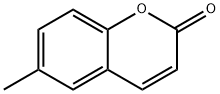
| Chemical Properties | 6-methylcoumarin is a white to almost white crystalline powder with has a somewhat coconut-like odor. the odor is also characterized as having a delicate fig or date sweetness. it has an almost bitter taste above 50 ppm, turning sweet and vanilla-like at lower levels. soluble in benzene, hot ethanol and non-volatile oil, insoluble in hot water. | | Occurrence | Has apparently not been reported to occur in nature | | Uses | 6-Methylcoumarin is a synthetic fragrance in cosmetics, toiletries and soaps. It mainly used to prepare flavors such as coconut, vanilla and caramel. | | Preparation | 6-methylcoumarin is synthesized from p-cresol and fumaric acid. Preheat 72% sulfuric acid to 80 °C, add a mixture of fumaric acid and p-cresol, keep the reaction at 160-170 °C for 3-4 hours, cool, pour into crushed ice to precipitate a precipitate, and filter. The filtrate was extracted with benzene, and after adding benzene, the obtained crude product was subjected to vacuum distillation to obtain 6-methylcoumarin. synthesis of 6-methylcoumarin: By heating 6-methyl coumarin-3-carboxylic acid to 300 to 340°C; by condensation of p-cresol-disulfonic acid with fumaric acid in the presence of H2SO4; by condensation of p-homosalicyclic aldehyde with malonic acid in the presence of aniline, followed by heating for the lactone; from salicylaldehyde with propionic acid anhydride and sodium propionate. | | Definition | ChEBI: 6-methylcoumarin is a member of the class of coumarins that is coumarin in which the hydrogen at position 6 is replaced by a methyl group. It has a role as a fragrance and an allergen. | | Aroma threshold values | Aroma characteristics at 1.0%: sweet vanilla cake, creamy, coconut, coumarin-like and powdery, with
herbaceous hay and tonka-like nuances. | | Taste threshold values | Taste characteristics at 5 ppm: coconut, sweet vanilla, dairy creamy, hay-like with anisic and coumarin
nuances. | | Synthesis Reference(s) | Tetrahedron, 62, p. 6918, 2006 DOI: 10.1016/j.tet.2006.04.080 | | General Description | 6-methylcoumarin appears as white crystals with a flavor of vanilla. Insoluble in water. (NTP, 1992) | | Air & Water Reactions | Insoluble in water. | | Reactivity Profile | Ketones, such as 6-Methylcoumarin, are reactive with many acids and bases liberating heat and flammable gases (e.g., H2). The amount of heat may be sufficient to start a fire in the unreacted portion of the ketone. Ketones react with reducing agents such as hydrides, alkali metals, and nitrides to produce flammable gas (H2) and heat. Ketones are incompatible with isocyanates, aldehydes, cyanides, peroxides, and anhydrides. They react violently with aldehydes, HNO3, HNO3 + H2O2, and HClO4. | | Fire Hazard | 6-Methylcoumarin is combustible. | | Biochem/physiol Actions | Taste at 5 ppm | | Safety Profile | Poison by
subcutaneous route. Moderately toxic by
ingestion. A skin irritant. Mutation data
reported. Combustible liquid. When heated
to decomposition it emits acrid smoke and
irritating fumes. |
| 6-Methylcoumarin Preparation Products And Raw materials |
|


 日本语
日本语 한국어
한국어 Français
 Deutsch
 España
 Türkiye