Other grades of this product :
| Ethyl isobutyrate Chemical Properties |
| Melting point | -88°C | | Boiling point | 112-113 °C (lit.) | | density | 0.865 g/mL at 25 °C (lit.) | | vapor density | 4.01 (vs air) | | vapor pressure | 40 mm Hg ( 33.8 °C) | | refractive index | n20/D 1.387(lit.) | | FEMA | 2428 | ETHYL ISOBUTYRATE | | Fp | 57 °F | | storage temp. | Flammables area | | solubility | alcohol: miscible(lit.) | | form | Liquid | | color | Clear colorless | | Odor Threshold | 0.000022ppm | | Water Solubility | Not miscible or difficult to mix in water. Soluble in alcohol. | | Merck | 14,3814 | | JECFA Number | 186 | | BRN | 773846 | | LogP | 1.8 at 22.9℃ | | CAS DataBase Reference | 97-62-1(CAS DataBase Reference) | | NIST Chemistry Reference | Propanoic acid, 2-methyl-, ethyl ester(97-62-1) | | EPA Substance Registry System | Ethyl isobutyrate (97-62-1) |
| Hazard Codes | F,Xi | | Risk Statements | 11-36/37/38 | | Safety Statements | 16-26-36-36/37/39 | | RIDADR | UN 2385 3/PG 2 | | WGK Germany | 2 | | RTECS | NQ4675000 | | TSCA | Yes | | HazardClass | 3 | | PackingGroup | II | | HS Code | 29156000 |
| Ethyl isobutyrate Usage And Synthesis |
| Chemical Properties | Colorless volatile liquid. With aromas of fruit and cream. Melting point is -88 DEG C, and boiling point is 112 ~ 113 C. Slightly soluble in water and miscible with most organic solvents.
The natural product is found in strawberries, honey, molasses, beer and champagne.
| | Uses | Used as food essence and flavoring, mainly used in the preparation of cream and strawberry, cherry and other fruit essences. It can also be used as raw flavoring in cigarettes, daily chemical products and other products. At the same time, it is also an excellent organic solvent.
| | Use restriction | FEMA(mg/kg):Soft drink 10; cold drink 25;sweets 73; baked food 200; puddings6.0; piping layers 1.5.
| | Preparation | Obtained by esterification of isobutyric acid and anhydrous ethanol. After mixing isobutyric acid and anhydrous ethanol, carefully add concentrated sulfuric acid. After refluxing the mixture for 14h, it should be washed by water and saturated sodium bicarbonate solution and dried by anhydrous magnesium sulfate and then go through distillation. Collecting fractions at 109-111℃ and obtain 2- methyl ethyl propionate. The yield is 69 percent.
| | Toxicity | GRAS (FEMA)
LD50800mg/kg (mice, subcutaneous )
| | Content Analysis | Adopt method one offered by the ester measurement. The sample is taken 1.0 gram by weight. Equivalent factor under calculation is taken at 58.08.
It should be measured with non-polar column method used in GT-10-4.
| | Chemical Properties | Ethyl isobutyrate has a fruity aromatic odor. | | Chemical Properties | CLEAR COLOURLESS LIQUID | | Occurrence | Reported found in apple juice, banana, chocolate, cognac, Concord grape, honey, apricot, orange, pineapple, rum,
strawberry, strawberry oil, watermelon, whiskey, champagne wine, grape wine, beer, port, passion fruit wine, sherry wine, orange juice,
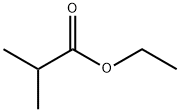
papaya, mango, kiwi fruit, quince, spineless monkey orange (Strychnos madagasc.), spearmint oil and Parmesan cheese. | | Uses | It is employed to make flavoring compounds and essences, as a flavoring agent and to flavor animal feeds. | | Uses | Ethyl Isobutyrate is a synthetic flavoring agent that is a stable, colorless liquid of dry, fruity odor. it should be stored in tin, glass, or resin-lined containers. it is used to give fruity effects to flavors for applications in candy, baked goods, and beverages at 10–100 ppm. | | Definition | ChEBI: Ethyl isobutyrate is a fatty acid methyl ester obtained by the formal condensation of isobutyric acid with ethanol. It has a role as a metabolite. It is functionally related to an isobutyric acid. | | Preparation | By esterification of ethanol with isobutyric acid under azeotropic conditions.
| | Aroma threshold values | Detection: 0.01 to 1 ppb | | Taste threshold values | Taste characteristics at 12.5 ppm: pungent, ethereal and fruity with a rum- and eggnog-like nuance. Taste
characteristics at 20 ppm: sweet, ethereal, fruity with a rum-like nuance | | Synthesis Reference(s) | Tetrahedron, 27, p. 2671, 1971 DOI: 10.1016/S0040-4020(01)98056-1Tetrahedron Letters, 28, p. 953, 1987 DOI: 10.1016/S0040-4039(00)95884-2 | | General Description | Ethyl isobutyrate appears as a colorless volatile liquid with a fruity, aromatic odor. Less dense than water and insoluble in water. Vapors heavier than air. May irritate skin and eyes. Used to make flavoring extracts and other chemicals. | | Air & Water Reactions | Highly flammable. Insoluble in water. | | Reactivity Profile | An ester. Esters react with acids to liberate heat along with alcohols and acids. Strong oxidizing acids may cause a vigorous reaction that is sufficiently exothermic to ignite the reaction products. Heat is also generated by the interaction of esters with caustic solutions. Flammable hydrogen is generated by mixing esters with alkali metals and hydrides. | | Health Hazard | May cause toxic effects if inhaled or absorbed through skin. Inhalation or contact with material may irritate or burn skin and eyes. Fire will produce irritating, corrosive and/or toxic gases. Vapors may cause dizziness or suffocation. Runoff from fire control or dilution water may cause pollution. | | Fire Hazard | HIGHLY FLAMMABLE: Will be easily ignited by heat, sparks or flames. Vapors may form explosive mixtures with air. Vapors may travel to source of ignition and flash back. Most vapors are heavier than air. They will spread along ground and collect in low or confined areas (sewers, basements, tanks). Vapor explosion hazard indoors, outdoors or in sewers. Runoff to sewer may create fire or explosion hazard. Containers may explode when heated. Many liquids are lighter than water. | | Safety Profile | Moderately toxic by
intraperitoneal route. A skin irritant.
Flammable liquid. A very dangerous fire
hazard when exposed to heat or flame; can
react vigorously with oxidizing materials. To
fight fire, use foam, CO2, dry chemical.
When heated to decomposition it emits
acrid smoke and irritating fumes. See also
ESTERS. | | Purification Methods | Wash the ester with aqueous 5% Na2CO3, then with saturated aqueous CaCl2. Dry it over CaSO4 and distil. [Beilstein 1 IV 846.] |
| Ethyl isobutyrate Preparation Products And Raw materials |
|


 日本语
日本语 한국어
한국어 Français
 Deutsch
 España
 Türkiye