Other grades of this product :
| Product Name: | 2,2-Dimethyl-1,3-propanediol | | Synonyms: | 1,3-Dihydroxy-2,2-dimethylpropane;1,3-propanediol,2,2-dimethyl-;2,2-Dimethyl-1,3-dihydroxypropane;NEOPENTYL GLYCO;2,2-DIMETHYL-1,3-PROPANEDIOL (NPG);2,2-Dimethyl-1,3 propandiol;2,2-dimethyl-1,3-propanediol (Neopentyl Glycol);2,2-Dimethylpropan-1,3-diol | | CAS: | 126-30-7 | | MF: | C5H12O2 | | MW: | 104.15 | | EINECS: | 204-781-0 | | Product Categories: | Organics;Intermediates of Dyes and Pigments;Pyridines | | Mol File: | 126-30-7.mol |
| 2,2-Dimethyl-1,3-propanediol Chemical Properties |
| Melting point | 126-128 °C | | Boiling point | 208 °C | | density | 1.06 | | vapor density | 3.6 (vs air) | | vapor pressure | <0.8 mm Hg ( 20 °C) | | refractive index | 1.4406 (estimate) | | Fp | 107 °C | | storage temp. | Inert atmosphere,Room Temperature | | solubility | 830g/l | | pka | 14.57±0.10(Predicted) | | form | Crystalline Chunks | | color | White | | explosive limit | 1.34%, 149°F | | Water Solubility | 830 g/L (20 ºC) | | Sensitive | Hygroscopic | | Merck | 14,6458 | | BRN | 605291 | | Stability: | Stable. Incompatible with strong oxidizing agents, acetic anhydride, acid chlorides, moisture. Combustible. | | LogP | -0.15 at 25℃ | | CAS DataBase Reference | 126-30-7(CAS DataBase Reference) | | NIST Chemistry Reference | 1,3-Propanediol, 2,2-dimethyl-(126-30-7) | | EPA Substance Registry System | Neopentyl glycol (126-30-7) |
| 2,2-Dimethyl-1,3-propanediol Usage And Synthesis |
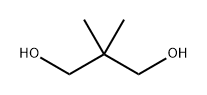
| Chemical Structure | The chemical formula for Neopentyl glycol (NPG) is C5H12O2, and it is a propane-1,3-diol carrying two methyl groups at position 2.Neopentyl glycol is soluble in water, benzene, chloroform, and very soluble in ethanol and diethyl ether. Neopentylglycol (NPG) is a unique polyalcohol offering superior performance advantages in many end-use applications due to its high chemical and thermal stability. It is a unique diol offering superior performance advantages in many end-use applications. These advantages are derived from its chemical structure. The location of the hydroxyl groups on primary carbon atoms allows rapid esterification. Additionally, the two methyl groups, instead of the usual two hydrogen atoms, on the alpha carbon atom are responsible for the high chemical and thermal stability of Neopentylglycol and its derivatives. | | Application | Neopentyl glycol is used in the synthesis of polyesters, paints, lubricants, and plasticizers. When used in the manufacture of polyesters, it enhances the stability of the product towards heat, light, and water. By esterification reaction with fatty or carboxylic acids, synthetic lubricating esters with reduced potential for oxidation or hydrolysis, compared to natural esters, can be produced. NPG is used primarily in base resins for coatings. In powder coating formulations, Neopentylglycol offers the additional advantage of providing small differences between the glass transition temperature and melting point. Important areas of application include general metal, appliance, metal furniture, automotive and machinery coatings. Important uses are also found in hydraulic fluids, synthetic lubricant oils, greases, metalworking fluids and aircraft engine lubricants. Other outlets include textiles, pharmaceuticals, pesticides, plasticizers and petroleum.
High quality NPG is shipped as flake, molten and slurry. The high-quality NPG is the component in polyester resins for industrial coatings and fiberglass-reinforced plastics applications, and most polyester resin formulations contain NPG as the sole glycol component, or it is used in conjunction with a modifying glycol to achieve desired properties. NPG is also used in polyester polyols for polyurethane coatings for the automotive, industrial maintenance, transportation, and aerospace markets.
| | Chemical Properties | white solid | | Uses | NPG Glycol is used in the synthesis of tetraphenylporphyrins. Also used in the synthesis of Bryostatin 2, a protein kinase modulator. | | Uses | In the manufacture of plasticizers, polyesters, as modifier of alkyd resins. | | Uses | 2,2-Dimethyl-1,3-propanediol may be used in the synthesis of:- 2,2-dimethyl-1,3-propanediol cyclic phosphorochloridate
- 2,2-dimethyl-1,3-propanediol cyclic phenylphosphonate
- [1′,3′-(2′,2′-dimethylpropylene)]-2-iodo-3-octyl-5-thienylboronate
- cyclic carbonate
- 2,2-dimethyl-1,3-propanediol bis(cyclic-2,2-dimethyltrimethylene phosphite)
| | General Description | White crystalline solid. Melting point 130°C. | | Air & Water Reactions | Soluble in water. | | Reactivity Profile | 2,2-Dimethyl-1,3-propanediol may generate toxic gases in combination of with alkali metals, nitrides, and strong reducing agents. Reacts with inorganic acids and carboxylic acids to form esters plus water. Converted to aldehydes or acids by oxidizing agents. May initiate the polymerization of isocyanates and epoxides. | | Health Hazard | May be harmful by ingestion or skin absorption. Causes eye and skin irritation. Material is irritating to mucous membrane and upper respiratory tract. INHALATION: Call for medical aid. Remove to fresh air. If breathing has stopped, give artificial respiration. If breathing is difficult, give oxygen. | | Fire Hazard | Special Hazards of Combustion Products: Emits toxic fumes under fire condition. | | Flammability and Explosibility | Nonflammable | | Purification Methods | Crystallise the diol from *benzene or acetone/water (1:1). [Beilstein 1 IV 2551.] |
| 2,2-Dimethyl-1,3-propanediol Preparation Products And Raw materials |
| Raw materials | Isobutyraldehyde-->Sodium formate-->Pivaldehyde | | Preparation Products | Sodium formate-->Triethylene glycol dimethacrylate-->Unsaturated polyester resin-->3-FLUORO-2-(5,5-DIMETHYL-1,3,2-DIOXABORINAN-2-YL)BENZONITRILE-->2-CHLORO-6-(5,5-DIMETHYL-1,3,2-DIOXABORINAN-2-YL)BENZONITRILE-->2-BROMO-6-(5,5-DIMETHYL-1,3,2-DIOXABORINAN-2-YL)BENZONITRILE-->4-(TRIFLUOROMETHYL)-2-(5,5-DIMETHYL-1,3,2-DIOXABORINAN-2-YL)BENZONITRILE-->3-METHOXY-2-(5,5-DIMETHYL-1,3,2-DIOXABORINAN-2-YL)BENZONITRILE-->4-CHLORO-2-(5,5-DIMETHYL-1,3,2-DIOXABORINAN-2-YL)BENZONITRILE-->2-METHOXY-6-(5,5-DIMETHYL-1,3,2-DIOXABORINAN-2-YL)BENZONITRILE-->5-(TRIFLUOROMETHYL)-2-(5,5-DIMETHYL-1,3,2-DIOXABORINAN-2-YL)BENZONITRILE-->2-(3-CHLOROPROPYL)-2,5,5-TRIMETHYL-[1,3]-DIOXANE-->2-(TRIFLUOROMETHYL)-6-(5,5-DIMETHYL-1,3,2-DIOXABORINAN-2-YL)BENZONITRILE-->2-CYANO-5-BROMOPHENYLBORONIC ACID PINACOL ESTER-->3,3-DIMETHYLCYCLOBUTANECARBOXYLIC ACID-->Ibuprofen-->ISOQUINOLINE-4-BORONIC ACID 2,2-DIMETHYLPROPANEDIOL-1,3 CYCLIC ESTER |
|


 日本语
日本语 한국어
한국어 Français
 Deutsch
 España
 Türkiye