| Synthesis | 1,2-Dimethoxyethane is derived from the reaction of ethylene glycol monomethyl ether with sodium metal and methyl chloride. The ethylene glycol monomethyl ether and the metal sodium were refluxed together until the metal sodium was completely reacted, the temperature was lowered to 45° C., and methyl chloride was introduced. After the reaction is completed, fractional distillation is performed to collect fractions at 84-85.5°C to obtain 1,2-Dimethoxyethane. |
| Chemical Properties | Colorless liquid |
| Uses | Solvent commonly employed in organometallic reactions,1 particularly organolithium reactions.2 May also function as a ligand.3 |
| Uses | Monoglyme is used in the electrolyte solutions for lithium batteries. |
| Uses | 1,2-Dimethoxyethane is widely used as a solvent for electrolyte of lithium batteries, polysilicones, oligo- and polysaccharides. It plays an important role in Grignard reactions, Suzuki reactions and Stille couplings in organometallic chemistry and in pharmaceutical synthesis. It is a higher boiling point solvent and is used as an alternative to diethyl ether and tetrahydrofuran. It is used for the etching of synthetic polymers like polytetrafluoroethylene and other fluoropolymers with alkali metal dispersions. |
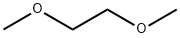
| Definition | ChEBI: A diether that is the 1,2-dimethyl ether of ethane-1,2-diol. |
| General Description | A liquid with a sharp odor. Less dense than water. Flash point 34°F. Mildly toxic by ingestion and inhalation. Severely irritates skin and eyes. Vapors heavier than air. Used to make other chemicals. |
| Air & Water Reactions | Highly flammable. Slightly soluble in water. |
| Reactivity Profile | When the solvent, 1,2-Dimethoxyethane, was poured into a funnel previously used to introduce the lithium aluminum hydride, a fire ignited the funnel, [MCA Case History 1182(1966)]. |
| Hazard | Moderate fire risk. |
| Health Hazard | If ingested causes nausea, vomiting, cramps, weakness, coma. |
| Fire Hazard | Behavior in Fire: Containers may explode in fires. |
| Flammability and Explosibility | Highlyflammable |
| Safety Profile | An experimental
teratogen. Other experimental reproductive
effects. Readdy forms an explosive peroxide.
A very dangerous fire hazard when exposed
to heat, flame, or oxidzers. Mixture with
lithium tetrahydroaluminate may ignite orexplode if heated. When heated to
decomposition it emits acrid smoke and
fumes. See also GLYCOL ETHERS. |
| Purification Methods | Traces of water and acidic materials have been removed from it by refluxing with Na, K or CaH2, decanting and distilling from Na, K, CaH2 or LiAlH4. The reaction has been speeded up by using vigorous high-speed stirring with molten potassium. For virtually complete elimination of water, 1,2-dimethoxyethane has been dried with Na-K alloy until a characteristic blue colour is formed in the solvent at Dry-ice/cellosolve temperatures: the solvent is kept with the alloy until distilled for use [Ward J Am Chem Soc 83 1296 1961]. Alternatively, glyme, refluxed with benzophenone and Na-K, is dry enough if, on distillation, it gives a blue colour of the ketyl immediately on addition to benzophenone and sodium [Ayscough & Wilson J Chem Soc 5412 1963]. It has also been purified by distillation under N2 from sodium benzophenone ketyl (see above). [Beilstein 1 IV 2376.] |


 日本语
日本语 한국어
한국어 Français
 Deutsch
 España
 Türkiye