Other grades of this product :
| Sunifiram Basic information |
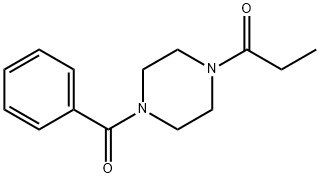
| Product Name: | Sunifiram | | Synonyms: | Piperazine, 1-benzoyl-4-(1-oxopropyl)-;SunifiraM;1-(4-Benzoyl-1-piperazinyl)-1-propanone;1-Benzoyl-4-(1-oxopropyl)-piperazine;1-(4-Benzoylpiperazin-1-yl)propan-1-one;Sunifiram DM235;1-Benzoyl-4-propanoylpiperazine;DM-235;DM 235;DM235 | | CAS: | 314728-85-3 | | MF: | C14H18N2O2 | | MW: | 246.3 | | EINECS: | 1312995-182-4 | | Product Categories: | pharmaceutical;314728-85-3 | | Mol File: | 314728-85-3.mol |
| Sunifiram Chemical Properties |
| Melting point | 92 - 94°C | | Boiling point | 442.0±38.0 °C(Predicted) | | density | 1.154±0.06 g/cm3 (20 ºC 760 Torr) | | storage temp. | 2-8°C | | solubility | H2O: soluble24mg/mL | | pka | 0.08±0.70(Predicted) | | form | solid | | color | white |
| Sunifiram Usage And Synthesis |
| Description | Sunifiram (DM-235) is a synthetic derivative of piracetam, although due to breaking the pyrrolidone backbone it is no longer in the racetam class of drugs (yet by being derived from them, it is still commonly associated with this class).Sunifiram has mechanisms similar to nefiracetam in the hippocampus, and similar to that drug sunifiram shows anti-amnesiac properties and is potentially a cognitive enhancer. Its anti-amnesiac activity is several orders of magnitude greater than piracetam on a per weight basis, and preliminary evidence suggest it has a similarly low toxicity profile. | | Uses | Sunifiram is a potent nootropic agent. | | Side effects | While initial research suggests that sunifiram is virtually non-toxic and doesn’t produce any notable side effects, it’s important to note how little research has been conducted on this compound. For this reason, it’s incredibly important that you begin with a low dosage before ramping up to a higher one, and pay close attention to any noted side effects you experience.Based on anecdotal evidence, some sunifiram users have experienced side effects such as:HeadacheHot flashesDifficulty sleepingManic feelingsThese side effects seem only to be mentioned with dosages outside of the 5-10mg range, with higher doses producing more pronounced side effects. If you find that you’re experiencing side effects as you up your dosage, ramp down your dosage to a level where no side effects are present. | | Mode of action | Sunifiram enhances NMDA-dependent signaling by increasing PKCα phosphorylation, at a dosage range of 10-100nM. This mechanism of action is dependent on the availability of the glycine binding site and Sunifiram has been shown to act as an antagonist to glycine at a concentration of 300μM.Furthermore, the increased activity of AMPA receptor activation has been associated with increased CAMKII and PKCα phosphorylation. Although studies have confirmed that intracellular proteins like CAMKII and PKCα are activated after Sunifiram administration, other proteins like CaMKIV and ERK remain unaffected.A brief summary of the mechanism of action, as it is currently understood, is that Sunifiram acts on the NMDA receptor’s glycine binding site, which results in increased signaling and activation of CAMKII and PKCα proteins and the subsequent positive regulation of AMPA receptors.Furthermore, animal studies have indicated that a dosage of 0.01mg/kg increases acetylcholine release by up to 200% within one hour of injection, in rat prefrontal cortex. This effect is not seen at a higher dosage of 1mg/kg. |
| Sunifiram Preparation Products And Raw materials |
|


 日本语
日本语 한국어
한국어 Français
 Deutsch
 España
 Türkiye