Other grades of this product :
| Pyridoxamine dihydrochloride Basic information |
| Pyridoxamine dihydrochloride Chemical Properties |
| Melting point | 224-226 °C (dec.)(lit.) | | density | 1.4025 (rough estimate) | | refractive index | 1.6100 (estimate) | | storage temp. | Inert atmosphere,Store in freezer, under -20°C | | solubility | DMSO (Slightly), Methanol (Slightly), Water (Slightly) | | form | Powder or Solid | | pka | pKa 3.31(H2O
t = 25
I = 0.1)(Approximate) | | color | White to off-white to pale brown | | Water Solubility | Soluble in DMSO, water, or methanol
/n | | Merck | 7980 | | BRN | 3632748 | | CAS DataBase Reference | 524-36-7(CAS DataBase Reference) |
| Hazard Codes | Xi | | Risk Statements | 36/37/38 | | Safety Statements | 26-36 | | WGK Germany | 2 | | RTECS | UV1230000 | | HazardClass | IRRITANT | | HS Code | 29333990 |
| Pyridoxamine dihydrochloride Usage And Synthesis |
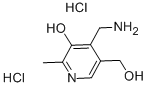
| Description | Pyridoxamine dihydrochloride is a salt of pyridoxamine, which belongs to the family of vitamin B6 compounds. Pyridoxamine occurs naturally in animal-based food products. Its deficiency in humans potentially causes sideroblastic anemia, weakness, insomnia, and neurological disorders. It has been reported to have been effective against diabetic nephropathy.Use in mammalian cell culture as an alternative to pyridoxine or pyridoxal. Vitamin B6 is a required component of cell culture media. Historically, media have been supplemented with vitamin B6 in the aldehyde form, pyridoxal. While this is a biologically active form of vitamin B6, it is unstable in liquid media. When cells are able to utilize either pyridoxine and/or pyridoxamine, they are preferred supplement versus pyridoxal. A number of classical media are now offered with a choice between pyridoxal and pyridoxine as the vitamin A source.https://www.sigmaaldrich.com/US/en/product/sial/p9380?context=product | | Chemical Properties | White crystalline powder | | Uses | Pyridoxamine dihydrochloride blocks pathogenic oxidative pathways in the progression of diabetic nephropathy.Pyridoxamine dihydrochloride, a derivative of vitaminB6 and potent inhibitor of AGE formation has been shown slowDKD progression, but only in patients with relatively preservedkidney function (i.e., baseline SCr 1.3 to 1.9 mg/dL).Pyridoxamine dihydrochloride (Pyridorin, NephroGenex) inhibits formation of advanced glycation end products and scavenges reactive oxygen species and toxic carbonyls. Whether these effects translate into kidney protection is unknown, although a year-long study of the effects of pyridoxamine dihydrochlo-ride in patients with type 2 diabetes and proteinuria failed to show a difference in kidney function decline with pyri-doxamine dihydrochloride in daily doses of 300 or 600 mg versus placebo treatment. | | Uses | Pyridoxamine Dihydrochloride (cas# 524-36-7) is a compound useful in organic synthesis. | | Definition | ChEBI: A hydrochloride obtained by combining pyridoxamine with two molar equivalents of hydrochloric acid. Used for treatment of diabetic nephropathy. | | Preparation | The invention relates to a preparation method of pyridoxamine dihydrochloride, belonging to the technical field of the preparation of water soluble vitamins. The preparation method comprises the following steps: preparing pyridoxal oxime: taking pyridoxine hydrochloride as initial raw material and water as a reaction medium, adding activated manganese dioxide and concentrated sulfuric acid to generate pyridoxal by the reaction, and then reacting with anhydrous sodium acetate and hydroxylamine hydrochloride to obtain pyridoxal oxime; preparing pyridoxamine dihydrochloride: firstly enabling pyridoxal oxime to react with acetic acid and zinc to obtain acetic acid solution containing pyridoxamine, then decompressing the solution and reclaiming the acetic acid to obtain slurry concentrate, decompressing and reclaiming the acetic acid again to obtain pyridoxamine water solution, regulating the pH value to be alkaline so as to separate pyridoxamine out, adding water and hydrochloric acid after vacuum filteration, decoloring and filtering to obtain filtrate, decompressing and concentrating the filtrate until white solids are separated out, adding solvent and stirring, and finally crystallizing at the lower temperature, filtering and drying to obtain the pyridoxamine dihydrochloride. The invention has the advantages that the prepared pyridoxamine dihydrochloride has high total mol yield and purity, and the preparation method is reduced.https://patents.google.com/patent/CN101628892A/en | | Purification Methods | The amine salt is crystallised from hot MeOH. The free base crystallises from EtOH with m 193-193.5o [Harris et al. J Biol Chem 154 315 1944, J Am Chem Soc 66 2088 1944]. [Beilstein 22 IV 6064, 22/12 V 324.] |
| Pyridoxamine dihydrochloride Preparation Products And Raw materials |
|


 日本语
日本语 한국어
한국어 Français
 Deutsch
 España
 Türkiye