Other grades of this product :
| 2-Cyanopyridine Basic information |
| 2-Cyanopyridine Chemical Properties |
| Melting point | 24-27 °C(lit.) | | Boiling point | 212-215 °C(lit.) | | density | 1.081 g/mL at 25 °C(lit.) | | vapor pressure | 11.96Pa at 25℃ | | refractive index | n20/D 1.529(lit.) | | Fp | 193 °F | | storage temp. | Inert atmosphere,Room Temperature | | solubility | 67g/l | | form | Low Melting Crystalline Solid | | pka | pK1:-0.26(+1) (25°C) | | color | White to brown | | PH | 8.4 (100g/l, H2O) | | Water Solubility | immiscible | | BRN | 107710 | | Exposure limits | NIOSH: IDLH 25 mg/m3 | | LogP | 0.45 at 25℃ | | CAS DataBase Reference | 100-70-9(CAS DataBase Reference) | | NIST Chemistry Reference | 2-Pyridinecarbonitrile(100-70-9) | | EPA Substance Registry System | 2-Pyridinecarbonitrile (100-70-9) |
| 2-Cyanopyridine Usage And Synthesis |
| Chemical Properties | white to brown low melting crystalline solid | | Chemical Properties | The cyanopyridines are as follows: 2-cyano-:
A white to tan liquid or solid. Almond odor. Boiling
point=2213℃
; freezing/melting point=27℃
; flash
point=89℃
. 3-cyano-: a colorless liquid or gray crystal-
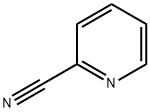
line solid. | | Uses | 2-Cyanopyridine is a cyano substituted pyridine. 2-Cyanopyridine is a related compound of nicotine and is a component of tobacco smoke condensate. | | Uses | It is employed as an important chemical intermediate for rimiterol hydrobromide and used as a bronchodilator. It is also used as intermediates of pharmaceutical and dye and pigment. It acts as a precursor of the respective amidate for protein modification via amidation. | | Definition | ChEBI: A cyanopyridine carrying the cyano group at position 2. | | Potential Exposure | Limits in Air
NIOSH IDLH525 mg/m3
NIOSH REL: (nitriles) 2 ppm, Ceiling Concentration, not
to be exceeded in any 15-minute work period. | | Shipping | UN3276 Nitriles, liquid, toxic, n.o.s., Hazard
Class: 6.1; Labels: 6.1-Poisonous materials, Technical
Name Required, Potential Inhalation Hazard (Special
Provision 5). | | Incompatibilities | Oxidizing agents, such as perchlorates,
peroxides, and permanganates. Nitriles may polymerize in
the presence of metals and some metal compounds. They
are incompatible with acids; mixing nitriles with strong
oxidizing acids can lead to extremely violent reactions.
Nitriles are generally incompatible with other oxidizing
agents such as peroxides and epoxides. The combination of
bases and nitriles can produce hydrogen cyanide. Nitriles
are hydrolyzed in both aqueous acid and base to give car-
boxylic acids (or salts of carboxylic acids). These reactions
generate heat. Peroxides convert nitriles to amides. Nitriles
can react vigorously with reducing agents. Acetonitrile and
propionitrile are soluble in water, but nitriles higher than
propionitrile have low aqueous solubility. They are also
insoluble in aqueous acids
. |
| 2-Cyanopyridine Preparation Products And Raw materials |
|

 日本语
日本语 한국어
한국어 Français
 Deutsch
 España
 Türkiye