Other grades of this product :
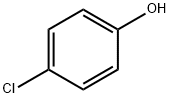
| 4-Chlorophenol Basic information |
| 4-Chlorophenol Chemical Properties |
| Melting point | 42-45 °C | | Boiling point | 220 °C (lit.) | | density | 1.306 g/mL at 25 °C (lit.) | | vapor density | 4.43 (vs air) | | vapor pressure | 1 mm Hg ( 49.8 °C) | | refractive index | 1.5579 | | Fp | 240 °F | | storage temp. | 2-8°C | | solubility | ethanol: soluble50mg/mL, clear to very slightly hazy, colorless to faintly brownish-yellow | | pka | 9.18(at 25℃) | | form | Low Melting Crystalline Mass | | color | White to pale yellow | | Odor | Phenolic | | Odor Threshold | 30 ppm | | Water Solubility | 2.7 g/100 mL (20 ºC) | | Sensitive | Air Sensitive | | Merck | 14,2154 | | BRN | 507004 | | Stability: | Stable. Incompatible with acid chlorides, acid anhydrides, oxidizing agents, iron. | | LogP | 2.5 at 35℃ | | CAS DataBase Reference | 106-48-9(CAS DataBase Reference) | | NIST Chemistry Reference | p-Chlorophenol(106-48-9) | | EPA Substance Registry System | p-Chlorophenol (106-48-9) |
| 4-Chlorophenol Usage And Synthesis |
| Chemical Properties | off-white to light tan crystals or powder | | Chemical Properties | All isomers have a characteristic odor. | | Uses | Intermediates of Liquid Crystals | | Uses | antineoplastic | | Uses | Biocide; disinfectant for home, hospital and farm. | | Uses | It is used as main raw material of compounding for medicine, dye, plastic and other industries. 4-Chlorophenol was used in visible-light-induced degradation of 4-chlorophenol in aqueous suspension of pure TiO2. | | Definition | ChEBI: A monochlorophenol substituted at the pare position by a chlorine atom. | | Synthesis Reference(s) | The Journal of Organic Chemistry, 50, p. 2145, 1985 DOI: 10.1021/jo00212a029Tetrahedron Letters, 24, p. 3117, 1983 DOI: 10.1016/S0040-4039(00)88111-3 | | General Description | White crystals with a strong phenol odor Slightly soluble to soluble in water, depending on the isomer, and denser than water. Noncombustible. Used as an intermediate in organic synthesis of dyes and drugs. | | Air & Water Reactions | Slightly soluble to soluble in water. | | Reactivity Profile | CHLOROPHENOLS, SOLID are incompatible with acid chlorides, acid anhydrides and oxidizing agents. Also incompatible with iron . Liquefy and darken in color at temperatures above 108°F. | | Hazard | Toxic by skin absorption, inhalation, or
ingestion; strong irritant to tissue. | | Health Hazard | Inhalation causes headache, dizziness, weak pulse. Ingestion causes irritation of mouth and stomach; headache, dizziness, weak pulse. Contact with eyes causes severe irritation and burning. Contact with skin causes irritation and burn; if absorbed, causes same symptoms as inhalation. | | Fire Hazard | Special Hazards of Combustion Products: Toxic and irritating hydrogen chloride and chlorine gases may form in fires. | | Flammability and Explosibility | Notclassified | | Safety Profile | Poison by inhalation
and intraperitoneal routes. Moderately toxic
by ingestion, skin contact, and subcutaneous
routes. A severe skin and eye irritant.
Human systemic effects by inhalation:
excitement, irritability. Mutation data
reported. Combustible when exposed to
heat or flame. To fight fire, use water, spray,
mist, fog, foam, dry chemical. When heated
to decomposition it emits toxic fumes of
Cl-. See also CHLOROPHENOLS and
CHLORIDES. | | Potential Exposure | Monochlorophenols are used in the
manufacture of fungicides, slimicides, bactericides, pesticides, herbicides, disinfectants, wood and glue preservatives; in the production of phenolic resins; in the extraction
of certain minerals from coal; as a denaturant for ethanol;
as an antiseptic; as a disinfectant, and others. | | Shipping | UN 2020 (solid); UN2021 (liquid) Chlorophenols, solid and liquid, Hazard Class: 6.1; Labels:
6.1-Poisonous materials. | | Purification Methods | Distil the phenol, then crystallise it from pet ether (b 40-60o) or hexane, and dry it under vacuum over P2O5 at room temperature. [Bernasconi & Paschalis J Am Chem Soc 108 2969 1986, Beilstein 6 IV 820.] | | Incompatibilities | May form explosive mixture with air.
Contact with oxidizing agents can cause fire and explosion
hazard. Heat produces hydrogen chloride and chlorine.
Corrosive to aluminum, copper and other chemically active
metals. | | Waste Disposal | Incinerate in admixture with
flammable solvent in furnace equipped with afterburner
and scrubber. |
| 4-Chlorophenol Preparation Products And Raw materials |
|


 日本语
日本语 한국어
한국어 Français
 Deutsch
 España
 Türkiye