Other grades of this product :
| (S)-(+)-Ketoprofen Basic information |
| (S)-(+)-Ketoprofen Chemical Properties |
| Melting point | 75-78 °C(lit.) | | Boiling point | 431.3±28.0 °C(Predicted) | | density | 1.198±0.06 g/cm3(Predicted) | | storage temp. | Sealed in dry,Room Temperature | | solubility | insoluble in H2O; ≥10.6 mg/mL in DMSO; ≥20.55 mg/mL in EtOH | | form | White solid. | | pka | 4.23±0.10(Predicted) | | optical activity | [α]22/D +49°, c = 1 in methanol | | CAS DataBase Reference | 22161-81-5(CAS DataBase Reference) |
| (S)-(+)-Ketoprofen Usage And Synthesis |
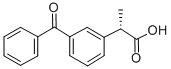
| Chemical Properties | White Solid | | Uses | COX inhibitor | | Uses | Anti-inflammatory; analgesic | | Definition | ChEBI: A monocarboxylic acid that is (S)-hydratropic acid substituted at position 3 on the phenyl ring by a benzoyl group. A cyclooxygenase inhibitor, it is used to relieve short-term pain, such as muscular pain, dental pain and dysmenorrhoea. | | Biological Activity | (s)-ketoprofen, a dual cox1/2 inhibitor, can be used as a nonsteroidal anti-inflammatory drug to treat arthritis-related inflammatory pains. ketoprofen is photolabile and undergoes degradation when irradiated by sunlight to induce various skin diseases [1]. | | Clinical Use | #N/A | | in vitro | the combination of uvb irradiation with ketoprofen dose-dependently induced the cytotoxicity and suppressed dna synthesis in hacat cells. uvb-irradiated kp inhibited the cell growth and induced g2/m cell cycle arrest by regulating the levels of cdc2, cyclin b1, chk1, tyr15-phosphorylated cdc2 and p21. the dapi staining results has revealed that kp accentuated the apoptotic response to uvb radiation in hacat cells [1]. | | in vivo | in a placebo-controlled, double-blind study in the rhesus monkeys macaca mulatta with periodontal disease, administeration of kp at 1% level in suitable topical vehicles to the gingiva once daily at a standard dose of 1.8 ml per monkey for 6 months effectively inhibited gcf-ltb4 and gcf-pge2 and positively altered alveolar bone activity [2]. ketoprofen at a dose of 3.63 mg/kg bwt (phenylbutazone equimolar dose) showed significant analgesic effects and reduced hoof pain and lameness to a greater extent [3]. treatment with ketoprofen (40 and 80 mg/kg diet) greatly reduced the incidence of transitional cell carcinoma of the urinary bladder by >70% from that seen in dietary mice [4]. | | Drug interactions | Potentially hazardous interactions with other drugsACE inhibitors and angiotensin-II antagonists:
antagonism of hypotensive effect; increased risk of
nephrotoxicity and hyperkalaemiaAnalgesics: avoid concomitant use of 2 or more
NSAIDs, including aspirin (increased side effects);avoid with ketorolac (increased risk of side effects
and haemorrhage).Antibacterials: possibly increased risk of convulsions
with quinolonesAnticoagulants: effects of coumarins and
phenindione enhanced; possibly increased risk of
bleeding with heparins, dabigatran and edoxaban -
avoid long term use with edoxabanAntidepressants: increased risk of bleeding with
SSRIs and venlaflaxine.Antidiabetic agents: effects of sulphonylureas enhanced.Antiepileptics: possibly increased phenytoin
concentration.Antivirals: increased risk of haematological toxicity
with zidovudine; concentration possibly increased by
ritonavir.Ciclosporin: may potentiate nephrotoxicity.Cytotoxics: reduced excretion of methotrexate;
increased risk of bleeding with erlotinib.Diuretics: increased risk of nephrotoxicity;
antagonism of diuretic effect, hyperkalaemia with
potassium-sparing diuretics.Lithium: excretion decreased.Pentoxifylline: increased risk of bleedingProbenecid: excretion reduced by probenecid.Tacrolimus: increased risk of nephrotoxicity | | Metabolism | Dexketoprofen is the S-enantiomer of ketoprofen.The
main elimination route for dexketoprofen is glucuronide
conjugation in the liver followed by renal excretion. | | references | [1]. liu s, mizu h, yamauchi h. molecular response to phototoxic stress of uvb-irradiated ketoprofen through arresting cell cycle in g2/m phase and inducing apoptosis[j]. biochemical and biophysical research communications, 2007, 364(3): 650-655.[2]. li k l, vogel r, jeffcoat m k, et al. the effect of ketoprofen creams on periodontal disease in rhesus monkeys[j]. journal of periodontal research, 1996, 31(8): 525-532.[3]. owens j g, kamerling s g, stanton s r, et al. effects of ketoprofen and phenylbutazone on chronic hoof pain and lameness in the horse[j]. equine veterinary journal, 1995, 27(4): 296-300.[4]. hawk e t, kelloff g j, mccormick d l. differential activity of aspirin, ketoprofen and sulindac as cancer chemopreventive agents in the mouse urinary bladder[j]. carcinogenesis, 1996, 17(5): 1435-1438. |
| (S)-(+)-Ketoprofen Preparation Products And Raw materials |
|


 日本语
日本语 한국어
한국어 Français
 Deutsch
 España
 Türkiye