Other grades of this product :
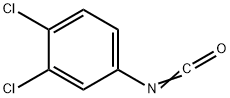
| Isocyanic acid 3,4-dichlorophenyl ester Basic information |
| Isocyanic acid 3,4-dichlorophenyl ester Chemical Properties |
| Isocyanic acid 3,4-dichlorophenyl ester Usage And Synthesis |
| Chemical Properties | White low melting solid | | Chemical Properties | The dichlorophenyl isocyanates are combustible, crystalline (sugar or sand-like) solids. In general, they
are white to yellow in color, but the 1,4-dichloro-2-phenyl
isomer is white to light green. Their flash points are
generally .113C but that of the 1,3-dichloro-2-phenyl isomer is reported as 77C. These chemicals are insoluble in
water, and some may be reactive. 1,2-dichloro-4-isomer
(CAS 102-36-3) is the isomer of regulatory focus | | Uses | Methyl-labeled diuron was prepared by the reaction of 3,4-dichlorophenyl- isocyanate with C '"labeled dimethylamine.Substituted urea derivatives were prepared by reacting 3,4-dichlorophenyl isocyanate with amino acids, dipeptides, histamine. The R- and S-isomers and RS-racemate of MBPU were synthesized by allowing equimolar quantities of 3,4-dichlorophenyl- isocyanate | | Uses | 3,4-Dichlorophenyl isocyanate was used in the synthesis of 1,5-disubstituted-2-thiobiuret derivatives via reaction with thioureido-containing aromatic/heterocyclic sulfonamides. | | General Description | White to yellow solid. Used as a chemical intermediate and in organic synthesis. | | Reactivity Profile | Isocyanates and thioisocyanates, such as Isocyanic acid 3,4-dichlorophenyl ester, are incompatible with many classes of compounds, reacting exothermically to release toxic gases. Reactions with amines, aldehydes, alcohols, alkali metals, ketones, mercaptans, strong oxidizers, hydrides, phenols, and peroxides can cause vigorous releases of heat. Acids and bases initiate polymerization reactions in these materials. Some isocyanates react with water to form amines and liberate carbon dioxide. | | Health Hazard | Strong irritant to tissue, especially eyes and mucous membranes | | Fire Hazard | Inhalation of dust is poisonous; fire may produce irritating or poisonous gases. | | Flammability and Explosibility | Notclassified | | Potential Exposure | Those materials used as chemical
intermediates | | Shipping | UN2250 Dichlorophenyl isocyanates, Hazard
Class: 6.1; Labels: 6.1-Poisonous materials. | | Incompatibilities | May form explosive mixture with air.
Isocyanates are highly flammable and reactive with many
compounds, even with themselves. Incompatible with
oxidizers (chlorates, nitrates, peroxides, permanganates,
perchlorates, chlorine, bromine, fluorine, etc.); contact may
cause fires or explosions. Reaction with moist air, water or
alcohols may form amines and insoluble polyureas and
react exothermically, releasing toxic, corrosive or flammable gases, including carbon dioxide; and, at the same time,
may generate a violent release of heat increasing theconcentration of fumes in the air. Incompatible with
amines, aldehydes, alkali metals, ammonia, carboxylic
acids, caprolactum, alkaline materials, glycols, ketones,
mercaptans, hydrides, organotin catalysts, phenols, strong
acids, strong bases, strong reducing agents such as
hydrides, urethanes, and ureas. Elevated temperatures or
contact with acids, bases, tertiary amines, and acylchlorides may cause explosive polymerization. Contact
with metals may evolve flammable hydrogen gas. Attacks
some plastics, rubber, and coatings. | | Waste Disposal | Combustion in an incinerator
equipped with afterburner and fume scrubber |
| Isocyanic acid 3,4-dichlorophenyl ester Preparation Products And Raw materials |
|

 日本语
日本语 한국어
한국어 Français
 Deutsch
 España
 Türkiye