Other grades of this product :
| Product Name: | Ciprofloxacin HCl | | Synonyms: | 3-Quinolinecarboxylic acid, 1-cyclopropyl-6-fluoro-1,4-dihydro-4-oxo-7-(1-piperazinyl)-, hydrochloride;1-cyclopropyl-6-fluoro-4-oxo-7-(piperazin-1-yl)-1,4-dihydroquinoline-3-carboxylic acid hydrochloride;3-Quinolinecarboxylicacid, 1-cyclopropyl-6-fluoro-1,4-dihydro-4-oxo-7-(1-piperazinyl)-,hydrochloride (1:1);CIPROFLOXACIN HYDROCHLORIDE;BAY-o-9867;Cyproxan;1-Cyclopropyl-6-fluoro-1,4-dihydro-4-oxo-7-(1-piperazinyl)-3-quinolinecarboxylic acid monohydrochloride;3-Quinolinecarboxylic acid, 1-cyclopropyl-6-fluoro-1,4-dihydro-4-oxo-7-(1-piperazinyl)-, monohydrochloride | | CAS: | 93107-08-5 | | MF: | C17H18FN3O3.HCl | | MW: | 367.8 | | EINECS: | 642-985-5 | | Product Categories: | Pharmaceutical intermediate | | Mol File: | 93107-08-5.mol |
| Ciprofloxacin HCl Chemical Properties |
| Melting point | >300 ºC | | storage temp. | Sealed in dry,Room Temperature | | solubility | insoluble in EtOH; ≥33.87 mg/mL in H2O; ≥9.34 mg/mL in DMSO with ultrasonic | | form | crystalline solid | | CAS DataBase Reference | 93107-08-5 |
| Safety Statements | 24/25 | | HS Code | 29339900 |
| Ciprofloxacin HCl Usage And Synthesis |
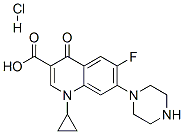
| Description | Ciprofloxacin hydrochloride is the hydrochloride of ciprofloxacin, which is a synthetic second-generation quinolone antibacterial drug with broad-spectrum antibacterial activity and good bactericidal effect. It is 2 to 4 times stronger than enoxacin, and has antibacterial effects on Enterobacter, Pseudomonas aeruginosa, Haemophilus influenzae, Neisseria gonorrhoeae, Streptococcus, Legionella, and Staphylococcus aureus. | | Mechanism of action | Ciprofloxacin hydrochloride is a new type of quinolone antibacterial drug. Its mechanism of action is that it can combine with bacterial DNA gyrase subunit A, thereby inhibiting the cleavage and linking functions of the enzyme, preventing the replication of bacterial DNA, and showing antibacterial effect. | | Uses | Ciprofloxacin hydrochloride, C17H18FN3O3 •HCl•H2O, is a synthetic broad-spectrum antibacterial agent. Ciprofloxacin differs from other quinolones in that it has a fluorine atom at the 6-position, a piperazine moiety at the 7-position, and a cyclopropyl ring at the 1-position. it was the drug of choice forcombating anthrax.
Ciprofloxacin hydrochloride (Cipro, 500-mg tablets) is highly active against the important bacterial causes of enteritis, including diarrheogenic Escherichia coli, Vibrio cholerae, Salmonella species, Shigella species, Campylobacter jejuni, Aeromonas species, and Yersinia enterocolitica.
| | Uses | Anti-bacterial | | Uses | Ciprofloxacin hydrochloride is a fluoroquinolone antibiotic that is widely used as an antimicrobial and immunomodulatory agent. Its range of activity includes most strains of bacterial pathogens capable of inducing respiratory, urinary tract, gastrointestinal, and abdominal infections. It functions by inhibiting DNA gyrase (a type II topoisomerase) and topoisomerase IV, the enzymes responsible for negative supercoiling of chromosomes and DNA strand separation, thus blocking initiation of bacterial replication. Most recently Ciprofloxacin hydrochloride has been used in the management of postexposure inhalational anthrax and radiation combined injury resulting from nuclear disasters.[Cayman Chemical]
| | Brand name | Ciloxan (Alcon); Cipro (Bayer); Proquin (Esprit). | | Biological Activity | ciprofloxacin (hydrochloride) is a fluoroquinolone antibiotic that has antimicrobial and immunomodulatory activities [1].ciprofloxacin functions by inhibiting dna gyrase and topoisomerase iv, the enzymes responsible for negative supercoiling of chromosomes and dna strand separation, thus blocking initiation of bacterial replication. topoisomerase iv is the primary target of ciprofloxacin in s. aureus [2].ciprofloxacin (hydrochloride) is a fluoroquinolone antibiotic that acts as an antimicrobial and immunomodulatory agent. in b6d2f1/j mice received radiation combined injury (ci), ciprofloxacin significantly reduced pro-inflammatory cytokine and chemokine concentrations (il-6 and kc), and enhanced il-3 production. cip also inhibited ci-induced apoptosis and autophagy in ileal villi, systemic bacterial infection, and iga production [1]. ciprofloxacin (hydrochloride) had been approved by fda for management of postexposure inhalational anthrax. in animals after exposure to aerosolized b. anthracis, ciprofloxacin significantly improved survival rate. ciprofloxacin inhibited the growth of b. anthracis with mic90 of 0.06 μg/ml. in the usamriid rhesus monkey model of inhalational anthrax, the maximum concentration (cmax) of ciprofloxacin was 1.74 μg/ml and the minimum concentration (cmin) was 0.17 μg/ml [3]. | | references | [1]. fukumoto r, cary lh, gorbunov nv, et al. ciprofloxacin modulates cytokine/chemokine profile in serum, improves bone marrow repopulation, and limits apoptosis and autophagy in ileum after whole body ionizing irradiation combined with skin-wound trauma. plos one. 2013;8(3):e58389.[2]. drlica k, zhao x. dna gyrase, topoisomerase iv, and the 4-quinolones. microbiol mol biol rev. 1997 sep;61(3):377-92.[3]. meyerhoff a, albrecht r, meyer jm, et al. us food and drug administration approval of ciprofloxacin hydrochloride for management of postexposure inhalational anthrax. clin infect dis. 2004 aug 1;39(3):303-8. |
| Ciprofloxacin HCl Preparation Products And Raw materials |
|


 日本语
日本语 한국어
한국어 Français
 Deutsch
 España
 Türkiye