Other grades of this product :
| 5-ETHYNYL-2'-DEOXYURIDINE Basic information |
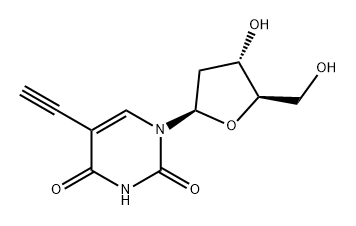
| Product Name: | 5-ETHYNYL-2'-DEOXYURIDINE | | Synonyms: | 5-ETHYNYL-2'-DEOXYURIDINE;2’-deoxy-5-ethynyl-uridin;2’-deoxy-5-ethynyluridine;EYdU;5-Ethynyl-durd;Aids072372;Aids-072372;2'deoxyuridine, 5-ethynyl | | CAS: | 61135-33-9 | | MF: | C11H12N2O5 | | MW: | 252.22 | | EINECS: | 500-100-4 | | Product Categories: | SiChem | | Mol File: | 61135-33-9.mol |
| 5-ETHYNYL-2'-DEOXYURIDINE Chemical Properties |
| Melting point | 199°C(lit.) | | density | 1.55±0.1 g/cm3(Predicted) | | storage temp. | -20°C | | solubility | Soluble in DMSO (up to 10 mg/ml). | | pka | 8.29±0.10(Predicted) | | form | powder | | color | White or off-white | | Stability: | Stable for 1 year from date of purchase as supplied. Solutions in DMSO may be stored at -20° for up to 2 months. | | InChIKey | CDEURGJCGCHYFH-DJLDLDEBSA-N | | CAS DataBase Reference | 61135-33-9 |
| Hazard Codes | T | | Risk Statements | 46-61 | | Safety Statements | 53-45-24/25 | | RTECS | YU7510000 | | HS Code | 29349990 |
| 5-ETHYNYL-2'-DEOXYURIDINE Usage And Synthesis |
| Description | 5-Ethynyl-2′-deoxyuridine (61135-33-9) is a novel agent for fast and sensitive detection of DNA synthesis?in vivo.1 5-EdU is incorporated into proliferating cells followed by detection with a fluorescent azide using click ligation.1 In contrast to the use of BrdU, the new method does not require sample fixation or DNA denaturation. 5-Ethynyl-2′-deoxyuridine may be used for studying cell proliferation in the central nervous system and may be combined with BrdU staining in a novel protocol allowing for double labeling of DNA synthesis.2 | | Uses | 5-Ethynyl-2’deoxyuridine is a extensively used nucleoside analog used as a probe for DNA synthesis. However, 5-Ethynyl-2’deoxyuridine is a toxic anti-metabolite, which potentially causes DNA instabi
liy, necrosis and cell-cycle arrest, therefore it is often used for short-term DNA synthesis in tissue culture and living organisms where prolonged cell survival is not required. | | Uses | 5-Ethynyl-2′-deoxyuridine (EdU) is a thymidine analog that can be incorporated into replicating DNA for detection of cell proliferation. It has an alkyne handle that can ligate with azide-containing fluorescent probes through a highly efficient click chemistry reaction. EdU nucleoside can be incorporated into the DNA of cells either in culture or in animals without showing significant toxicity. The assay offers a simpler workflow for detecting cell proliferation than anti-BrdU assays.For information on Baseclick kits containing all the reagents for the assays see: Baseclick kitsFor a listing of the Baseclick kits see: Baseclick kits | | References | 1) Salic and Mitchison (2008),?A chemical method for fast and sensitive detection of DNA synthesis in vivo; Proc. Natl. Acad. Sci. USA,?105?2415
2) Zeng?et al. (2010),?Evaluation of 5-ethynyl-2′-deoxyuridine staining as a sensitive and reliable method for studying cell proliferation in the adult nervous system; Brain Res.,?1319C?21 |
| 5-ETHYNYL-2'-DEOXYURIDINE Preparation Products And Raw materials |
|


 日本语
日本语 한국어
한국어 Français
 Deutsch
 España
 Türkiye