Other grades of this product :
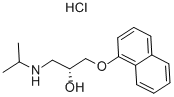
| Product Name: | (R)-(+)-PROPRANOLOL | | Synonyms: | R-PROPANOLOL;R-(+)-PROPANOLOL HCL;2R-(+)-Propanolol hydrochloride≥ 95% (GCMS);(R)-(+)-Propanolol hydrochloride for synthesis;2R-(+)-PROPANOLOL HYDROCHLORIDE;2-Propanol, 1-(1-methylethyl)amino-3-(1-naphthalenyloxy)-, hydrochloride, (2R)-;(+)-Anapriline;2-Propanol, 1-(isopropylamino)-3-(1-naphthyloxy)-, hydrochloride, (+)- (8CI) | | CAS: | 13071-11-9 | | MF: | C16H21NO2.ClH | | MW: | 295.81 | | EINECS: | 235-961-7 | | Product Categories: | Amines;Aromatics;Intermediates & Fine Chemicals;Pharmaceuticals | | Mol File: | 13071-11-9.mol |
| (R)-(+)-PROPRANOLOL Chemical Properties |
| Melting point | 196-198 °C(lit.) | | storage temp. | Store below +30°C. | | solubility | ethanol: 10 mg/mL | | form | Solid | | color | White to Off-White | | BRN | 5780490 | | CAS DataBase Reference | 13071-11-9(CAS DataBase Reference) |
| Hazard Codes | Xn | | Risk Statements | 22 | | Safety Statements | 22-24/25 | | WGK Germany | 3 | | HS Code | 2922 19 00 |
| (R)-(+)-PROPRANOLOL Usage And Synthesis |
| Description | (R)-Propranolol hydrochloride is the less active enantiomer of the anti-adrenoceptor (β-adrenoceptor) antagonist propranolol (HY-B0573). Propranolol is a nonselective β-adrenergic receptor (βAR) antagonist with high affinity for β1AR and β2AR with Ki values of 1.8 nM and 0.8 nM, respectively. | | Physical Properties | (R)-Propranolol's solubility:ethanol: 10 mg/mLDMSO: <14.5 mg/mLH2O: 50 mg/mL (With heat. Aqueous solutions are most stable at pH 3.0 and decompose rapidly at basic pH. Decomposition is accompanied by discoloration of the solution.) | | Uses | less active enantiomer | | Uses | The R-enantiomer of Propranolol (P831800). β?Adrenergic blocker. Antihypertensive; antianginal; antiarrhythmic (class II). | | Biochem/physiol Actions | Less active enantiomer of propranolol. | | Mechanism of action | Pronolol hydrochloride is a non-selective beta-receptor blocker that blocks beta receptors in the myocardium and has antagonistic effects on beta1 and beta2 receptors. Slow down the heart rate, inhibit cardiac contractility and conduction, reduce circulating blood volume, and reduce myocardial oxygen consumption. | | Purification Methods | The hydrochloride is recrystallised from n-PrOH or Me2CO. It is soluble in H2O and EtOH but is insoluble in Et2O, *C6H6 or EtOAc. The racemate has m 163-164o, and the free base recrystallises from cyclohexane with m 96o. [Howe & Shanks Nature 210 1336 1966.] The S-isomer (below) is the physiologically active isomer. |
| (R)-(+)-PROPRANOLOL Preparation Products And Raw materials |
|


 日本语
日本语 한국어
한국어 Français
 Deutsch
 España
 Türkiye