Other grades of this product :
| 6-Dimethylaminopurine Basic information |
| 6-Dimethylaminopurine Chemical Properties |
| Melting point | 259-262 °C(lit.) | | Boiling point | 162 °C (50 mmHg) | | density | 1.1407 (rough estimate) | | refractive index | 1.6380 (estimate) | | Fp | 110 °C | | storage temp. | -20°C | | solubility | methanol: 0.1 g/mL, clear | | form | prilled | | pka | 9.38±0.20(Predicted) | | color | off-white to yellow | | BRN | 7634 | | InChIKey | BVIAOQMSVZHOJM-UHFFFAOYSA-N | | CAS DataBase Reference | 938-55-6(CAS DataBase Reference) | | NIST Chemistry Reference | 1H-Purin-6-amine, N,N-dimethyl-(938-55-6) |
| Hazard Codes | | WGK Germany | 3 | | RTECS | UO7440636 | | HS Code | 29335990 |
| 6-Dimethylaminopurine Usage And Synthesis |
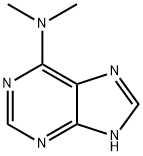
| Chemical Properties | white to light yellow crystal powder | | Uses | 6-Dimethylaminopurine is a serine threonine protein kinase inhibitor. It inhibits the germinal vesicle breakdown and the meiotic maturation of oocytes. It can be used to rtificially lengthen the pre-maturation period of oocyte growth, in vitro, by inhibiting germinal vesicle breakdown in mouse and human oocytes. | | Definition | ChEBI: 6-Dimethylaminopurine is a tertiary amine that is adenine substituted at N-6 by geminal methyl groups. It is functionally related to an adenine. | | Application | 6-(Dimethylamino)purine has been used:as a supplement in GR-1 aa medium (bovine medium) for parthenogenetic activation of bovine oocytes to study its potential for embryo development.in the activation step during the production of nuclear transfer embryos.as a supplement in HCR2aa medium to activate interspecies embryos derived from interspecies somatic cell nuclear transfer (iSCNT) technique.A purine antagonist.In the benzodiazepine receptor (BZR) binding assay, it inhibits the binding of 1.5 nM [3H]diazepam at 100uM in rat brains. | | Preparation | 6-Dimethylaminopurine synthesis: 2-Methylmercapto-4-amino-6-dimethylaminopyrimidine (VI) was smoothly nitrosated in 10% acetic acid to the 5-nitrosopyrimidine (V) in 95% yield. Reduction of V with sodium hydrosulfite to the triamine (IV), followed by formylation gave the 5-formamidopyrimidine (VII) in 76% over-all yield for the two steps. Reductive formylation of V directly to VI1 with zinc and formic acid, although more rapid, was less efficient (50% yield). Ring closure of VII to 2-methyhercapto-6-dimethylaminopurine (X) was best done on a small scale by short fusion at 250°(99% yield), although boiling quinoline, formamide, or dilute alcoholic sodium hydroxide could also be employed. The latter reagent was most efficient on a large scale. Desulfurization of X with Raney nickel (7) in 1 N sodium hydroxide at 100° afforded the final product, 6-dimethylaminopurine (XII) in 43% yield.This compound was identical in all respects with the C7H9N5 moiety from puromycin (2). | | General Description | 6-(Dimethylamino)purine (6-DMAP) is a purine-based metabolite with two condensed heterocyclic rings and two methyl groups linked to the amino group of the purine unit of adenine. | | Biochem/physiol Actions | 6-(Dimethylamino)purine (6-DMAP) is a protein kinase and cyclin-dependent kinase inhibitor. It acts as a secondary metabolite and mediates RNA modification. 6-DMAP is a potent cytokinetic inhibitor and is used in parthenogenesis and meiosis studies. It is also used to promote pronuclei formation in mammalian oocytes. 6-DMAP is a dual fluorescence molecule according to femtosecond fluorescence up-conversion spectroscopy studies. | | Purification Methods | It is purified by recrystallisation from H2O, EtOH (0.32g in 10mL) or CHCl3. [Albert & Brown J Chem Soc 2060 1954, UV: Mason J Chem Soc 2071 1954.] The monohydrochloride crystallises from EtOH/Et2O, m 2 5 3o(dec) [Elion et al. J Am Chem Soc 74 411 1952], the dihydrochloride has m 225o(dec) and the picrate has m 245o (235-236.5o) [Fryth et al. J Am Chem Soc 80 2736 1958]. [Beilstein 26 III/IV 3566.] |
| 6-Dimethylaminopurine Preparation Products And Raw materials |
|


 日本语
日本语 한국어
한국어 Français
 Deutsch
 España
 Türkiye