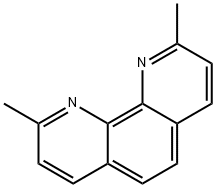
| Neocuproine Basic information |
| Product Name: | Neocuproine |
| Synonyms: | TIMTEC-BB SBB008718;NEOCUPROINE REAG;NEOCUPROINE;10-Phenanthroline,2,9-dimethyl-1;2,9-dimethyl-10-phenanthroline;2,9-Dimethyl-o-phenanthroline;2,9-Dimethylphenanthroline;2,9 DiMethy 1,10-phenanthrofine |
| CAS: | 484-11-7 |
| MF: | C14H12N2 |
| MW: | 208.26 |
| EINECS: | 207-601-9 |
| Product Categories: | Analytical Chemistry;Chelating Reagents;Phenanthrolines;MOFS COFS |
| Mol File: | 484-11-7.mol |
| Neocuproine Chemical Properties |
| Melting point | 159-164 °C |
| Boiling point | 337.46°C (rough estimate) |
| density | 1.1345 (rough estimate) |
| refractive index | 1.6152 (estimate) |
| RTECS | SF8380000 |
| storage temp. | Keep in dark place,Sealed in dry,Room Temperature |
| solubility | methanol: 0.1 g/mL, clear |
| form | crystalline |
| pka | 6.01±0.30(Predicted) |
| color | white to beige |
| Water Solubility | slightly soluble |
| Sensitive | Light Sensitive |
| Merck | 6449 |
| InChIKey | IYRGXJIJGHOCFS-UHFFFAOYSA-N |
| CAS DataBase Reference | 484-11-7(CAS DataBase Reference) |
| NIST Chemistry Reference | 1,10-Phenanthroline, 2,9-dimethyl-(484-11-7) |
| EPA Substance Registry System | 1,10-Phenanthroline, 2,9-dimethyl- (484-11-7) |
| Safety Information |
| Hazard Codes | Xi,Xn |
| Risk Statements | 36/37/38-20/21/22-22 |
| Safety Statements | 26-36/37/39-36-24/25 |
| WGK Germany | 3 |
| TSCA | Yes |
| HS Code | 29339990 |
| MSDS Information |
| Provider | Language |
|---|---|
| Neocuproine | English |
| ACROS | English |
| Neocuproine Usage And Synthesis |
| Chemical Properties | OFF-WHITE TO VERY PALE YELLOW CRYSTALLINE POWDER |
| Uses | Due to the steric hindrance of the methyl groups attached to the carbon atoms adjacent to the nitrogen donor atoms of phenanthroline, the reagent does not give the low spin vivid red complex characteristic of phenanthroline derivatives with iron(II). However, in the presence of reducing agents it reacts with copper to give a copper(I) complex of composition MA2 and of tetrahedral symmetry. This chelate is insoluble in water and can be extracted by chloroform in which the absorption maximum of the complex appears at 457 nm. In this way the concentration of the complex can be measured. The method is suitable for the determination of copper in iron, manganese and vanadium ores even in the presence of aluminium, germanium, titanium and silicon. Neocuproine is today considered one of the most selective reagents. Unfortunately, it is rather expensive. 2,3-bis-(2-pyridyl)quinoxaline, prepared by Belcher et al. by condensation of o-diketone, 2,2'-dipyridyl and 0-phenylenediamine(44) contains the functional grouping characteristic of cuproine; it is quite suitable for the determination of copper and it is cheap. Starting with various substituted o-phenylene-diamines Belcher synthesized 25 different quinoxaline derivatives, of which 2,3-bis-[2-(-methyl)-pyridyl)]quinoxaline proved to be identical with neocuproine as regards analytical selectivity. Besides copper, titanium(III) is the only metal ion which gives a colour reaction with the reagent. However, the coloured titanium(III) complex is formed only at lower pH and hence it does not interfere with the determination of copper. The copper complex of the reagent can be extracted quantitatively with isopentyl alcohol usually as a perchlorate ion pair. |
| Uses | Neocuproine is a phenanthroline based metal ion chelating agent. |
| Definition | ChEBI: A member of the class of phenanthrolines that is 1,10-phenanthroline bearing two methyl substituents at positions 2 and 9. |
| Purification Methods | Purifiy it as the hemihydrate by crystallisation from water and as the anhydrous base from *benzene. [Beilstein 23/8 V 527.] |
| Neocuproine Preparation Products And Raw materials |
Please leave a message for us or use the following ways to contact us, we will reply to you as soon as possible, and provide you with the most sincere service, thank you.


 日本语
日本语 한국어
한국어 Français
 Deutsch
 España
 Türkiye