Other grades of this product :
| 3-Aminobenzamide Basic information |
| 3-Aminobenzamide Chemical Properties |
| Melting point | 115-116 °C (lit.) | | Boiling point | 250.42°C (rough estimate) | | density | 1.1778 (rough estimate) | | refractive index | 1.5769 (estimate) | | storage temp. | room temp | | solubility | ethanol: 50 mg/mL, clear, faintly yellow | | form | powder | | pka | 16.26±0.50(Predicted) | | color | white to off-white | | Water Solubility | Soluble in dimethylformamide (~30 mg/ml), dimethyl sulfoxide (~30 mg/ml), phosphate buffered saline (pH7.2) (~2 mg/ml), water (25 mg/ml), and ethanol (25 mg/ml). | | Sensitive | Light Sensitive | | BRN | 2802373 | | Stability: | Stable for 1 year from date of purchase as supplied. Solutions in DMSO or ethanol may be stored at -20°C for up to 1 month. | | CAS DataBase Reference | 3544-24-9(CAS DataBase Reference) | | NIST Chemistry Reference | 3-NH2-C6H4CONH2(3544-24-9) |
| 3-Aminobenzamide Usage And Synthesis |
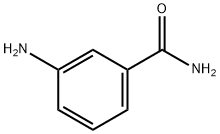
| Description | The poly(ADP-ribose) polymerases (PARPs) comprise a family of enzymes which post-translationally modify proteins by poly(ADP-ribosyl)ation. Since some PARPs are activated by DNA strand breaks, PARP signaling has roles in DNA repair, apoptosis, inflammation, and other cellular responses. 3-amino Benzamide is an inhibitor of PARPs (Ki = 1.8 μM). Through its effects on PARPs, 3-amino benzamide causes telomere shortening and stimulates angiogenesis. It has PARP-mediated actions in such diverse diseases as atherosclerosis, neurogenesis, and cancer. | | Chemical Properties | beige powder | | Uses | The poly(ADP-ribose) polymerases (PARPs) comprise a family of enzymes which post-translationally modify proteins by poly(ADP-ribosyl)ation. Since some PARPs are activated by DNA strand breaks, PARP signaling has roles in DNA repair, apoptosis, inflammation, and other cellular responses. 3-amino Benzamide is an inhibitor of PARPs (Ki = 1.8 μM). Through its effects on PARPs, 3-amino benzamide causes telomere shortening and stimulates angiogenesis. It has PARP-mediated actions in such diverse diseases as atherosclerosis, neurogenesis, and cancer. | | Uses | 3-Aminobenzamide is used as an endogenous poly-ADP-ribosyltransferase inhibitor. Through its effects on PARPs, 3-amino benzamide causes telomere shortening and stimulates angiogenesis. It displays neuroprotective, anti-necrotic effects. | | Definition | ChEBI: A substituted aniline that is benzamide in which one of the meta- hydrogens is replaced by an amino group. | | Biochem/physiol Actions | 3-Aminobenzamide enhances cell death, unscheduled DNA synthesis and repair replication by interrupting the rejoining of DNA strand breaks induced by both ionizing radiations and several alkylating agents. It has an ability to inhibit the activity of nuclear enzyme poly (ADP-ribose) synthetase (PARS). 3-Aminobenzamide exhibits protective action against myocardial reperfusion injury and local inflammation. | | References | 1) Purnell and Whish (1980), Novel inhibitors of poly(ADP-ribose) synthetase; Biochem. J., 185 775
2) Kuo et al. (1996), Inhibitors of poly(ADP-ribose) polymerase block nitric oxide-induced apoptosis but not differentiation in human leukemia HL-60 cells; Biochem. Biophys. Res. Commun., 219 502
3) Malorni et al. (1995), 3-Aminobenzamide protects cells from UV-B-induced apoptosis by acting on cytoskeleton and substrate adhesion; Biochem. Biophys. Res. Commun., 207 715
4) Heller et al. (1995), Inactivation of the poly(ADP-ribose) polymerase gene affects oxygen radical and nitric oxide toxicity in islet cells; J. Biol. Chem., 270 11176 |
| 3-Aminobenzamide Preparation Products And Raw materials |
|


 日本语
日本语 한국어
한국어 Français
 Deutsch
 España
 Türkiye