Other grades of this product :
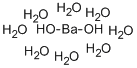
| Barium hydroxide octahydrate Basic information |
| Barium hydroxide octahydrate Chemical Properties |
| Melting point | 78 °C(lit.) | | Boiling point | 780°C | | density | 2.18 | | storage temp. | Store at +5°C to +30°C. | | solubility | 72g/l | | form | Solid | | Specific Gravity | 2.18 | | color | White | | PH | 14 (H2O, 20℃)(saturated aqueous solution) | | Odor | Odorless | | PH Range | 12.5 at 50 g/l at 20 °C | | Water Solubility | 56 g/L (15 ºC) | | Sensitive | Air Sensitive & Hygroscopic | | Merck | 14,977 | | Exposure limits | ACGIH: TWA 0.5 mg/m3NIOSH: IDLH 50 mg/m3; TWA 0.5 mg/m3 | | Stability: | Stable. | | CAS DataBase Reference | 12230-71-6(CAS DataBase Reference) |
| Hazard Codes | C | | Risk Statements | 20/22-34-20/21 | | Safety Statements | 26-36/37/39-45 | | RIDADR | UN 3262 8/PG 2 | | WGK Germany | 1 | | RTECS | CQ9200000 | | F | 9-34 | | TSCA | Yes | | HazardClass | 8 | | PackingGroup | III | | HS Code | 28164000 | | Toxicity | LD50 orally in Rabbit: 550 mg/kg |
| Barium hydroxide octahydrate Usage And Synthesis |
| Description | Barium hydroxide is available as colourless or white crystals. It is odourless and soluble
in water. It is stable under ordinary conditions of use and storage. It is incompatible with
acids, oxidisers, and chlorinated rubber. Barium hydroxide is corrosive to metals such
as zinc. Barium hydroxide is very alkaline and rapidly absorbs carbon dioxide from air,
becoming completely insoluble in water. Barium hydroxide is used in analytical chemistry
for the titration of weak acids. Barium hydroxide is used in organic synthesis as a strong
base. Barium hydroxide decomposes to barium oxide when heated to 800°C. | | Chemical Properties | white crystalline powder | | Uses | Barium hydroxide octahydrate is extensively used in the manufacturing of barium salts and barium organic compounds; In manufacture of alkali, glass; in synthetic rubber vulcanization, in corrosion inhibitors, pesticides, sugar industry; boiler scale remedy; refining animal and vegetable oils; softening water. Catalyst in organic synthesis.
| | Uses | In manufacture of alkali, glass; in synthetic rubber vulcanization, in corrosion inhibitors, pesticides, sugar industry; boiler scale remedy; refining animal and vegetable oils; softening water. Catalyst in organic synthesis. | | Uses | Used in manufacture of alkali, glass; in synthetic rubber vulcanization, alkalizing agent in water softening, boiler scale remedy, softening water.Barium hydroxide octahydrate is used in the centromeric heterochromatin banding technique. It acts as a precursor to prepare barium titanate, barium sulfate, barium phosphate and barium sulfide. Further, it is used in analytical chemistry for the titration of weak acids especially organic acids. It is involved in the preparation of cyclopentanone, diacetone alcohol and D-Gulonic gamma-lactone. In addition to this, it finds application in ester hydrolysis such as dimethyl hendecanedioate and decarboxylation of amino acids. | | Application | Catalyzes the β-elimination of phosphoserine residues.Resin stabilizer; manufacture of oil and grease additives; raw material of pigment; sulfate removal agent. | | Purification Methods | It crystallises from water (1mL/g) and readily absorbs CO2 from air. It effloresces to the monohydrate. It dehydrates to Ba(OH)2 in dry air at 100o. An aqueous solution (baryta water) absorbs CO2 to form a white precipitate of BaCO3. |
| Barium hydroxide octahydrate Preparation Products And Raw materials |
|


 日本语
日本语 한국어
한국어 Français
 Deutsch
 España
 Türkiye