Other grades of this product :
| Dacthal Basic information |
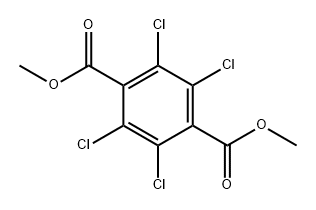
| Product Name: | Dacthal | | Synonyms: | FATAL(R);LABOTEST-BB LT00455685;CHLORTHAL-DIMETHYL;CHLORTHAL-METHYL;CHLORTHAL-METHYL(R);DCPA METHYL ESTER(R);DAC 893(R);DACTHAL | | CAS: | 1861-32-1 | | MF: | C10H6Cl4O4 | | MW: | 331.96 | | EINECS: | 217-464-7 | | Product Categories: | Organic acids | | Mol File: | 1861-32-1.mol |
| Dacthal Chemical Properties |
| Dacthal Usage And Synthesis |
| Chemical Properties | Colorless crystalline | | Chemical Properties | Colorless to gray crystalline solid. Practically
odorless. | | Uses | Pre-emergent herbicide. | | Uses | Selective, nonsystemic, preemergent herbicide to control most annual grasses and
many broad-leaved weeds. | | Uses | Dacthal is used as a preemergent herbicide. | | Potential Exposure | DCPA is an alkyl phthalate; benzene-
dicarboxylic acid herbicide, pesticide pre-emergent herbi-
cide is used on annual broadleaf weeds and grasses
in a wide spectrum of vegetable crops. | | Environmental Fate | Soil. Bartha and Pramer (1967) reported that DCPA was degraded by soil microorganisms via cleavage of the herbicide molecule into propionic acid and 3,4-dichloroaniline.
The acid was mineralized to carbon dioxide and water and two molecules of 3,4-dichloroaniline were condensed to form 3,3′4,4′-tetrachloro-azobenzene. Metabolites identified
in soil and turfgrass thatch are monomethyl tetrachloroterephthalate and 2,3,5,6-tetrachloroterephthalic acid (Hartley and Kidd, 1987; Krause and Niemczyk, 1990). Residual
activity in soil and the half-life in soil were reported to be approximately 3 months (Hartley
and Kidd, 1987; Worthing and Hance, 1991) | | Shipping | UN3077 Environmentally hazardous substances,
solid, n.o.s., Hazard class: 9; Labels: 9-Miscellaneous
hazardous material, Technical Name Required. | | Incompatibilities | May react violently with strong oxidi-
zers, bromine, 90% hydrogen peroxide, phosphorus
trichloride, silver powders or dust. Incompatible with silver
compounds. Mixture with some silver compounds forms
explosive salts of silver oxalate. | | Waste Disposal | Incineration in a unit with
efficient gas scrubbing. Containers must be disposed of
properly by following package label directions or by con-
tacting your local or federal environmental control agency,
or by contacting your regional EPA office. |
| Dacthal Preparation Products And Raw materials |
|


 日本语
日本语 한국어
한국어 Français
 Deutsch
 España
 Türkiye