Other grades of this product :
| 1,1,3,3-Tetramethylurea Basic information |
| 1,1,3,3-Tetramethylurea Chemical Properties |
| Melting point | −1 °C(lit.) | | Boiling point | 177 °C(lit.) | | density | 0.968 g/mL at 20 °C(lit.) | | refractive index | n20/D 1.451(lit.) | | Fp | 150 °F | | storage temp. | Inert atmosphere,Room Temperature | | solubility | Miscible with water, petroleum ether and common solvents. | | form | Liquid | | pka | 2.0(at 25℃) | | color | Clear colorless to pale yellow | | PH | 5-8 (25℃, 1M in H2O) | | Relative polarity | 5 | | Water Solubility | H2O: 1 M at 20 °C, miscible | | Merck | 14,9230 | | BRN | 773898 | | InChIKey | AVQQQNCBBIEMEU-UHFFFAOYSA-N | | CAS DataBase Reference | 632-22-4(CAS DataBase Reference) | | NIST Chemistry Reference | Urea, tetramethyl-(632-22-4) | | EPA Substance Registry System | Tetramethylurea (632-22-4) |
| 1,1,3,3-Tetramethylurea Usage And Synthesis |
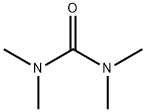
| Chemical Properties | Tetramethylurea is a clear colorless to pale yellow liquid with mild aromatic odor that is miscible with water and many organic solvents. Unusual for an urea is the liquid state of tetramethylurea in a range of > 170 °C. | | Uses | Tetramethylurea is used as a solvent in dyestuff industries, in condensation reaction and intermediates in surfactant. It is utilized for base catalyzed isomerization and alkylation hydrocyanation due to its low permittivity. It reacts with oxalyl chloride to prepare tetramethyl chloroformamidinium chloride, which is used for the conversion of carboxylic acids and dialkyl phosphates to anhydrides and pyrophosphates respectively. | | Definition | ChEBI: 1,1,3,3-tetramethylurea is a member of the class of ureas that is urea substituted by methyl groups at positions 1, 1, 3 and 3 respectively. Metabolite observed in cancer metabolism. It has a role as a human metabolite. | | Preparation | The reaction of dimethylamine with phosgene in the presence of e. g. 50 % sodium hydroxide solution and subsequent extraction with 1,2-dichloroethane yields tetramethylurea in 95% yield. | | Safety Profile | Moderately toxic by ingestion and intravenous routes. An experimental teratogen. Experimental reproductive effects. Human mutation data reported. Combustible when exposed to heat, flame, and oxidizers. To fight fire, use foam, mist, spray, dry chemicals. When heated to decomposition it emits toxic fumes of NOx. | | Purification Methods | Dry it over BaO and distil it under nitrogen. It denatures proteins in H2O. [Elbaum & Herskovits Biochemistry 13 1268 1974, Kane Anal Biochem 53 350 1973, Beilstein 4 IV 225.] |
| 1,1,3,3-Tetramethylurea Preparation Products And Raw materials |
|


 日本语
日本语 한국어
한국어 Français
 Deutsch
 España
 Türkiye