Other grades of this product :
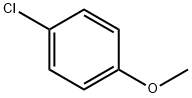
| 4-Chloroanisole Basic information |
| 4-Chloroanisole Chemical Properties |
| Melting point | -18 °C (lit.) | | Boiling point | 198-202 °C (lit.) | | density | 1.164 g/mL at 25 °C (lit.) | | vapor pressure | 1.08hPa at 25℃ | | refractive index | n20/D 1.535(lit.) | | Fp | 173 °F | | storage temp. | Sealed in dry,Room Temperature | | form | Liquid | | color | Clear colorless to yellow | | Water Solubility | immiscible | | BRN | 1858901 | | Stability: | Stable. Combustible. Incompatible with strong oxidizing agents. | | LogP | 2.78 at 25℃ | | CAS DataBase Reference | 623-12-1(CAS DataBase Reference) | | NIST Chemistry Reference | Benzene, 1-chloro-4-methoxy-(623-12-1) | | EPA Substance Registry System | Benzene, 1-chloro-4-methoxy- (623-12-1) |
| Hazard Codes | Xn | | Safety Statements | 23-24/25 | | RIDADR | UN 2810 | | WGK Germany | 3 | | TSCA | Yes | | HS Code | 29093090 |
| 4-Chloroanisole Usage And Synthesis |
| Chemical Properties | colourless liquid | | Uses | 4-Chloroanisole was found to react with Cu (II)-smectite forming a blue clay-organic complex. 4-Chloroanisole was chosen as the main test substrate for the optimisation studies as it is electronically deactivated and thus resistant to oxidative addition and consequently very reluctant to enter a catalytic manifold. | | Synthesis Reference(s) | Chemistry Letters, 16, p. 1901, 1987The Journal of Organic Chemistry, 35, p. 528, 1970 DOI: 10.1021/jo00827a060 | | General Description | 4-Chloroanisole is an electron-rich chloroarene. It undergoes Ullmann-type homocoupling catalyzed by in situ generated Pd colloids. Reaction of 4-chloroanisole with Cu(II)-smectite in n-hexane, carbon tetrachloride or dichloromethane has been studied. The nucleophilic photosubstitution reactions, photocyanation and photohydrolysis of 4-chloroanisole has been studied by time resolved spectroscopy. | | Purification Methods | Wash the anisole with 10% (by volume) aqueous H2SO4 (three times), 10% aqueous KOH (three times), and then with water until neutral. Dry it (MgSO4), and fractionally distil it from CaH2 through a glass helices-packed column under reduced pressure. [Beilstein 16 IV 822.] |
| 4-Chloroanisole Preparation Products And Raw materials |
|


 日本语
日本语 한국어
한국어 Français
 Deutsch
 España
 Türkiye