Other grades of this product :
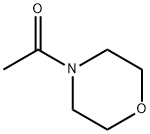
| N-Acetylmorpholine Basic information | | Uses |
| N-Acetylmorpholine Chemical Properties |
| Melting point | 14 °C (lit.) | | Boiling point | 240-245 °C | | density | 1.116 g/mL at 25 °C (lit.) | | vapor pressure | 2.2Pa at 20℃ | | refractive index | n20/D 1.483(lit.) | | Fp | >230 °F | | storage temp. | Sealed in dry,Room Temperature | | form | clear liquid | | pka | -0.72±0.20(Predicted) | | Specific Gravity | 1.116 | | color | Colorless to Light yellow | | Water Solubility | MISCIBLE | | BRN | 111971 | | LogP | -0.81 at 24℃ | | CAS DataBase Reference | 1696-20-4(CAS DataBase Reference) | | NIST Chemistry Reference | Morpholine, 4-acetyl-(1696-20-4) | | EPA Substance Registry System | Morpholine, 4-acetyl- (1696-20-4) |
| N-Acetylmorpholine Usage And Synthesis |
| Uses | N-Acetylmorpholine is a very important pesticide intermediate. It is one of the main raw materials for the synthesis of agricultural fungicides enoylmorpholine and flumorpholine. | | Chemical Properties | CLEAR COLOURLESS TO VERY SLIGHTLY YELLOW LIQUID | | Flammability and Explosibility | Nonflammable | | Purification Methods | Distil it through an 8inch Fenske (glass helices packing, p 11) column with a manual take-off head. Purify it by fractional distillation. The hydrobromide has m 172-175o. [Brace J Am Chem Soc 75 357 1953, deBenneville et al. J Org Chem 21 1072 1956, Beilstein 27 III/IV 274.] |
| N-Acetylmorpholine Preparation Products And Raw materials |
|


 日本语
日本语 한국어
한국어 Français
 Deutsch
 España
 Türkiye