Other grades of this product :
| Product Name: | Cyromazine | | Synonyms: | Vetrazin【pesticide】;Cyromazine, 2-Cyclopropylamino-4,6-diamino-s-triazine;N-Cyclopropyl;5-triazine-2,4,6-triamine,n-cyclopropyl-3;ai3-52713;cga72662;neoprex;Cyromazine (200 mg) | | CAS: | 66215-27-8 | | MF: | C6H10N6 | | MW: | 166.18 | | EINECS: | 266-257-8 | | Product Categories: | Pharmaceutical intermediate;Pesticide;Acaricides;Analytical Standards;Analytical/Chromatography;Building Blocks;Chemical Synthesis;Chromatography;Environmental Standards;Heterocyclic Building Blocks;Metabolites;Pesticides;Pesticides &Triazines;FINE Chemical & INTERMEDIATES;Active Pharmaceutical Ingredients;INSECTICIDE;fine chemicals, specialty chemicals, intermediates, electronic chemical, organic synthesis, insecticide;Bases & Related Reagents;Heterocycles;Nucleotides;Pesticide intermediates;66215-27-8 | | Mol File: | 66215-27-8.mol |
| Cyromazine Chemical Properties |
| Melting point | 223-227 °C (lit.) | | Boiling point | 284.39°C (rough estimate) | | density | 1.3196 (rough estimate) | | vapor pressure | 4.5 x l0-7 Pa (25 °C) | | refractive index | 1.8300 (estimate) | | Fp | 100 °C | | storage temp. | 2-8°C | | solubility | DMSO (Slightly), Methanol (Slightly) | | pka | 5.2 (base) | | Water Solubility | 13 g l-1 (pH 7.1,25 °C) | | form | neat | | color | White to Off-White | | Merck | 14,2775 | | BRN | 882879 | | Stability: | Hygroscopic | | InChIKey | LVQDKIWDGQRHTE-UHFFFAOYSA-N | | LogP | -0.061 at 25℃ | | CAS DataBase Reference | 66215-27-8(CAS DataBase Reference) | | NIST Chemistry Reference | Cyromazine(66215-27-8) | | EPA Substance Registry System | Cyromazine (66215-27-8) |
| Hazard Codes | Xi | | Risk Statements | 36/37/38 | | Safety Statements | 26-36 | | RIDADR | UN3077 (solid) | | WGK Germany | 2 | | RTECS | XZ1056500 | | HS Code | 29336990 | | Hazardous Substances Data | 66215-27-8(Hazardous Substances Data) | | Toxicity | LC50 (96-hour) for rainbow trout and carp >100 mg/L and bluegill sunfish >90
mg/L (Hartley and Kidd, 1987); acute oral LD50 for rats 3,387 mg/kg (Hartley and Kidd,
1987) |
| Cyromazine Usage And Synthesis |
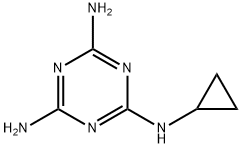
| Description | Cyromazine is a triazine insect growth regulator that can be used as an insecticide and an acarcide. It is a kind of cyclopropylderivative of melamine, and also belongs to the family of aminotriazines which are compound consisting of an amino group attached to a triazine ring. It has specific activity against dipterous larvae, and has been approved by FDA for being applied to livestock. It is not a kind of cholinesterase inhibitor, and taking effect through affecting the nervous system of the immature larval stage of the insects.
| | References | https://pubchem.ncbi.nlm.nih.gov/compound/cyromazine#section=Top
https://en.wikipedia.org/wiki/Cyromazine
http://pmep.cce.cornell.edu/profiles/insect-mite/cadusafos-cyromazine/cyromazine/insect-prof-cyromazine.html
| | Chemical Properties | White crystalline powder. The solubility in water is 11,000 mg/L at 20°C and pH 7.5, and the hydrolysis is not obvious at pH 5-9. | | Uses | Cypromazine is a high-efficiency and low-toxicity insecticide. It is mainly used to control leafminer pests, has a good control effect on Liriomyza, and can also be used to control flies. | | Application | Cyromazine is an insect growth regulator, used to control fly larvae in livestock and poultry manure. It can be fed directly to livestock or applied directly to fly breeding sites. Cyromazine also exhibits systemic activity and is used as a foliar spray to control leaf miners in vegetables, potatoes, etc., and on mushrooms. | | Definition | ChEBI: Cyromazine is a triamino-1,3,5-triazine. It has a role as a triazine insecticide and a mouse metabolite. | | Preparation | Cyromazine is prepared by the reaction of cyanuric chloride and cyclopropylamine to obtain 2-Cyclopropylamino-4,6-dichloro-triazepine, and then reacts with ammonia to obtain 2-Cyclopropylamino-4-chloro-6-aminostriazepine, and then reacting with ammonia to produce. | | General Description | N-Cyclopropyl-2,4,6-triamino-1,3,5-triazine, also known as cyromazine, is an insect growth regulator(IGR) that is commonly used as an insecticide. It undergoes metabolism in plants and animals to form melamine. Surface-enhanced Raman scattering (SERS) spectroscopic study indicates that it interacts with the surface of silver colloid through the lone pair on nitrogen. | | Flammability and Explosibility | Notclassified | | Agricultural Uses | Insecticide (insect growth regulator): As an insect growth regulator, cyromazine is fed to caged poultry and is passed through the chicken, leaving a residue in the manure. The chemical controls the growth of the fly larvae developing in the manure. Used as a foliar spray to control leaf miners in vegetables, mushrooms, potatoes and ornamentals and to control flies on animals. | | Trade name | ARMOR®; CITATION; CGA-72662®; LARVADEX®; PATRON®; TRIGARD®; VETRAZIN® | | Environmental Fate | Chemical/Physical. Cyromazine will react with mineral acids (e.g., hydrochloric acid,
sulfuric acid) forming water-soluble salts | | Metabolic pathway | Information presented in this summary is abstracted from the data evaluation
published by the Pesticide Safety Directorate (PSD, 1993). The major
degradation pathway of cyromazine involves the N-dealkylation of the
cyclopropyl moiety to yield melamine. Both cyromazine and melamine are
quite stable to biotransformation. Deamination and the formation of
N-methylcyromazine were observed as minor pathways. | | Degradation | Cyromazine (1) is stable to hydrolysis at pH 5, 7 and 9 and 70 °C
for up to 28 days. No degradation of cyromazine was observed when
irradiated under mercury vapour lamp (>290 nm) at 25 °C for up to 168 hours. |
| Cyromazine Preparation Products And Raw materials |
|


 日本语
日本语 한국어
한국어 Français
 Deutsch
 España
 Türkiye