Other grades of this product :
| Penconazole Basic information |
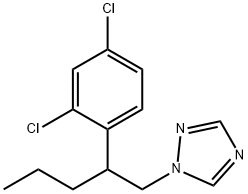
| Product Name: | Penconazole | | Synonyms: | 1-[2-(2,4-Dichlorophenyl)-n-pentyl]-1H-1,2,4-triazole;1-[2-(2,4-DICHLOROPHENYL)PENTYL]-1,2,4-TRIAZOLE;1-[2-(2,4-DICHLOROPHENYL)PENTYL]-1H-1,2,4-TRIAZOLE;PENCONAZOL;PENCONAZOLE;4-triazole,1-(2-(2,4-dichlorophenyl)pentyl)-1h-2;cga71818;onmex | | CAS: | 66246-88-6 | | MF: | C13H15Cl2N3 | | MW: | 284.18 | | EINECS: | 266-275-6 | | Product Categories: | Alpha sort;ConazolesPesticides&Metabolites;Fungicides;N-PAlphabetic;P;PA - PEN;FUNGICIDE;Pesticides | | Mol File: | 66246-88-6.mol |
| Penconazole Chemical Properties |
| Melting point | 58.5 °C | | Boiling point | 436.06°C (rough estimate) | | density | 1.2556 (rough estimate) | | vapor pressure | 3.7 x l0-4 Pa (25 °C) | | refractive index | 1.6300 (estimate) | | Fp | 100 °C | | storage temp. | 0-6°C | | form | neat | | Water Solubility | 73 mg l-1 (25 °C) | | pka | 2.80±0.10(Predicted) | | color | White | | BRN | 541488 | | CAS DataBase Reference | 66246-88-6(CAS DataBase Reference) | | EPA Substance Registry System | Penconazole (66246-88-6) |
| Safety Statements | 22-24/25 | | RIDADR | UN 3077 9 / PGIII | | WGK Germany | 2 | | RTECS | XZ4615000 | | HS Code | 29339900 | | Toxicity | LD50 skn-rat: >3 g/kg DOVEAA 38,195,84 |
| Penconazole Usage And Synthesis |
| Uses | Penconazole is an conazole based fungicide that works by inhibiting cell membrane ergosterol biosynthesis, thus stopping the development of fungi. | | Uses | Penconazole is used for the control of powdery mildew,
pome fruit scab and other pathogenic Ascomycetes, Basidiomycetes and
Deuteromycetes on vines, cucurbits, pome fruit, stone fruit, ornamentals,
hops, tobacco and vegetables. | | Agricultural Uses | Fungicide: Penconazole is a systemic fungicide used to control
powdery mildew. It is used on apples and grapes and
other fruits, hops, tobacco, ornamentals and on vegetables.
Not currently registered in the U.S. Reported to be used in
most European countries. Currently, there are more than
30 global suppliers. | | Trade name | AWARD®; CGA-71818®; ONMEX®;
TOPAS®; TOPAS-C®; TOPAS-MZ®; TOPAZ®;
TOPAZE®; TOPAZE-C®; TOPENCO 100EC® | | Safety Profile | Moderately toxic by ingestion and skin contact. When heated to decomposition it emits toxic vapors of NOx and Clí. | | Metabolic pathway | Penconazole is metabolised in plants by hydroxylation of the propyl side
chain and conjugation or metabolism to triazolylalanine and triazolylacetic
acid. It is quite persistent in soils but degradation by sunlight
requires only a few days. It is eliminated rapidly from mammals. | | Degradation | Penconazole (1) is stable to hydrolysis at pH 1-13 and at temperatures up
to 350 °C. It is degraded in sunlight with a DT50 of 4 days in natural sunlight.
Its photochemical reactions have been studied. On irradiation with
light of wavelengths greater than 280 nm (high-pressure mercury lamp
with filter), the major reaction was the formation of a cyclised product (2)
(Scheme 1). Irradiation under the same conditions in isopropanol gave
mainly 2 and 3 (a dechlorinated product). After 8 hours, yields were 29.8%
of 2 and 12.3% of 3 respectively. The product 3 alone photodegraded
only slowly but 2 was completely photolysed within 3 hours to further
products, indicating its role as an intermediate in the photolytic pathways
(Schwack and Hartmann, 1992, 1994). In the presence of isopropanol,
photodehalogenation of 3 to 4 competed with substitution of a
solvent molecule to give a low yield ( |
| Penconazole Preparation Products And Raw materials |
|


 日本语
日本语 한국어
한국어 Français
 Deutsch
 España
 Türkiye