Other grades of this product :
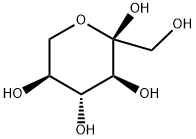
| L-(-)-SORBOSE Basic information |
| L-(-)-SORBOSE Chemical Properties |
| Melting point | 163-165 °C | | alpha | -43 º (C=5% IN H2O) | | Boiling point | 232.96°C (rough estimate) | | density | 1.65 g/cm | | refractive index | -43 ° (C=1, H2O) | | storage temp. | Inert atmosphere,2-8°C | | solubility | H2O: 0.1 g/mL, clear, colorless to very faintly yellow | | form | Crystalline Powder or Crystals and Chunks | | pka | pKa (17.5° ): 11.55 | | color | White to off-white | | Odor | Odorless | | optical activity | [α]20/D 43±2°, c = 5% in H2O | | Water Solubility | 354.8g/L(17 ºC) | | Merck | 14,8726 | | BRN | 1724554 | | CAS DataBase Reference | 87-79-6(CAS DataBase Reference) | | NIST Chemistry Reference | L-Sorbose(87-79-6) | | EPA Substance Registry System | L-Sorbose (87-79-6) |
| L-(-)-SORBOSE Usage And Synthesis |
| Chemical Properties | White to off-white crystalline powder or crystals | | Uses | In the manufacture of vitamin C (accounts for nearly 1000 tons of ascorbic acid produced every year). For conversion of L-sorbose to 2-keto-L-gulonic acid see Reichstein, Grüssner, Helv. Chim. Acta 17, 311 (1934). | | Uses | L-Sorbose is a low molecular weight naturally occurring monosaccharide carbohydrate molecule. It has sweetness that is nearly equivalent to that of sucrose. This is a labeled analog. | | Uses | L-Sorbose is used as a starting reagent for the commercial biosynthesis of ascorbic acid (vitamin C). | | Biochem/physiol Actions | The L enatiomer of sorbose, a ketohexose monosaccharide. |
| L-(-)-SORBOSE Preparation Products And Raw materials |
|

 日本语
日本语 한국어
한국어 Français
 Deutsch
 España
 Türkiye