Other grades of this product :
| D-arabinitol Basic information |
| D-arabinitol Chemical Properties |
| Melting point | 101-104 °C | | Boiling point | 194.6°C (rough estimate) | | alpha | +10~+14゜(20℃/D)(c=5,Na2B4O7 soln.) | | density | 1.1497 (rough estimate) | | refractive index | 1.3960 (estimate) | | storage temp. | Sealed in dry,Room Temperature | | solubility | H2O: 0.1 g/mL, clear, colorless | | form | Fine Crystalline Powder | | pka | 13.24±0.20(Predicted) | | color | White to off-white | | Water Solubility | Soluble in water (50 mg/ml). | | Merck | 14,762 | | BRN | 1720520 | | CAS DataBase Reference | 488-82-4(CAS DataBase Reference) | | EPA Substance Registry System | D-Arabinitol (488-82-4) |
| D-arabinitol Usage And Synthesis |
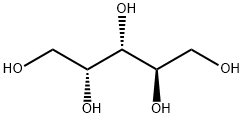
| Description | D-arabinitol is a characteristic metabolic product of candida species. While candida ssp. produces exclusively D-arabinitol, L-arabinitol is developed by the body’s own metabolism. D-arabinitol serum levels increase if candida yeasts proliferate within the organism and cause invasive Candidiasis. Both D-arabinitol and L-arabinitol are present in normal urine, and can easily be measured by gas chromatography of urine samples collected on filter paper. | | Chemical Properties | white to off-white fine crystalline powder | | Occurrence | D-Arabinitol (lyxitol) is found in lichens; in a variety of fungi; in the urediospores of wheat stem rust; in the dried herbiage of the Peruvian shrub, pichi, along with D-mannitol, dulcitol, and perseitol; and in the avocado. It is formed by fermentation of glucose and in 40% yields using blackstrap molasses. D-Arabinitol is formed by catalytic hydrogenation of D-arabinose in the presence of Raney nickel and from the γ-lactones of D-arabinonic and D-lyxonic acids by reduction with sodium borohydride. | | Uses | D-Arabitol, a rare sugar alcohol, is a substrate used to identify, differentiate and characterize enzyme such as the gluconobacter oxydans dehydrogenase(s), Gox2181, hyperthermophilic D-arabitol dehydrogenase from Thermotoga maritime and NAD-dependent D-arabitoldehydrogenase from acetic acid bacterium, Acetobacter suboxydans. | | Definition | ChEBI: D-arabinitol is the D-enantiomer of arabinitol. It is an enantiomer of a L-arabinitol. It is a metabolite found in the aging mouse brain. | | Biotechnological Applications | D-arabinitol detectionAnother approach to the diagnosis of invasive candidosis involves the detection in serum or urine of a metabolite, D-arabinitol, which is produced by most of the medically important Candida species with the exception of C. krusei and perhaps C. glabrata. Various methods have been developed to measure D-arabinitol concentrations in human serum and urine, including enzymatic-fluorometric and enzymatic-colorimetric procedures. Because increased levels of arabinitol are also found in human body fluids when renal function is impaired, the results are reported as the D-arabinitol- creatinine ratio. Although several large studies have demonstrated that patients with candidaemia have ele- vated serum D-arabinitol- creatinine ratios, this approach has still to achieve widespread clinical use. | | Purification Methods | This pentol, which occurs in lichens and fungi, is purified by recrystallisation from 90% EtOH or MeOH. [Ashina & Yamagita Chem Ber 67 801 1934, derivarives: Nakagawa et al. Bull Chem Soc Jpn 40 2150 1967, Prince & Reichstein Helv Chim Acta 20 101 1937, Hough & Theobald Methods in Carbohydrate Chemistry I 94 1962, Academic Press, Beilstein 1 IV 2832.] |
| D-arabinitol Preparation Products And Raw materials |
|


 日本语
 한국어
 Français
 Deutsch
 España
 Türkiye