Other grades of this product :
| Proglumide Basic information |
| Proglumide Chemical Properties |
| Toxicity | LD50 in mice (mg/kg): 2211-2649 i.v.; 7350-8861 orally (Rovati) |
| Proglumide Usage And Synthesis |
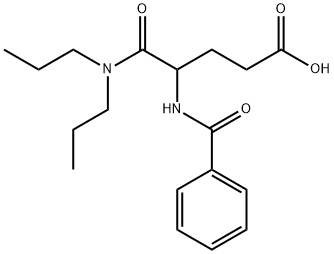
| Description | Proglumide (Milid) is a drug that inhibits gastrointestinal motility and reduces gastric secretions. It acts as a cholecystokinin antagonist, which blocks both the CCKA and CCKB subtypes. It was used mainly in the treatment of stomach ulcers, although it has now been largely replaced by newer drugs for this application.Proglumide is a nonpeptide and orally active cholecystokinin (CCK)-A/B receptors antagonist. Proglumide selective blocks CCK’s effects in the central nervous system (CNS). Proglumide has ability to inhibit gastric secretion and to protect the gastroduodenal mucosa. Proglumide also has antiepileptic and antioxidant activities. | | Chemical Properties | White Solid | | Uses | Anticholinergic. | | Brand name | Nulsa (Wallace). | | Side effects | An interesting side effect of proglumide is that it enhances the analgesia produced by opioid drugs, and can prevent or even reverse the development of tolerance to opioid drugs. This can make it a useful adjuvant treatment to use alongside opioid drugs in the treatment of chronic pain conditions such as cancer, where opioid analgesics may be required for long periods and development of tolerance reduces clinical efficacy of these drugs.Proglumide has also been shown to act as a δ-opioid agonist, which may contribute to its analgesic effects. | | Safety Profile | Moderately toxic by severalroutes. An experimental teratogen. When heated todecomposition it emits toxic fumes of NOx. | | Enzyme inhibitor | This anticholinergic agent (FWfree-acid = 334.42 g/mol; CAS 6620-60-6), also known as DL-4-benzamido-N,N-dipropylglutaramic acid and 4- (benzoylamino)-5-(dipropylamino)-5-oxopentanoic acid, is a cholecystokinin receptor antagonist. Proglumide A also exerts an inhibitory effect on gastric secretion and reduces gastrointestinal motility. It finds use clinically as a therapy for gastrointestinal ulcers. Target(s): cholecystokinin receptor; gastrin receptor. |
| Proglumide Preparation Products And Raw materials |
|


 日本语
日本语 한국어
한국어 Français
 Deutsch
 España
 Türkiye