Other grades of this product :
| Allylthiourea Basic information |
| Allylthiourea Chemical Properties |
| Melting point | 70-72 °C(lit.) | | Boiling point | 191.3±33.0 °C(Predicted) | | density | 1.11 g/mL at 25 °C(lit.) | | refractive index | 1.5936 (estimate) | | storage temp. | Store below +30°C. | | solubility | H2O: soluble30 parts | | form | Powder, Crystals, Granules or Chunks | | pka | 14.57±0.70(Predicted) | | Specific Gravity | 1.111.219 (20/20℃) | | color | White to light beige | | Water Solubility | 67 g/L (20 ºC) | | Merck | 14,9362 | | BRN | 1071470 | | Stability: | Stable. Incompatible with strong oxidizing agents. | | InChIKey | HTKFORQRBXIQHD-UHFFFAOYSA-N | | CAS DataBase Reference | 109-57-9(CAS DataBase Reference) | | NIST Chemistry Reference | Allylthiourea(109-57-9) | | EPA Substance Registry System | Allylthiourea (109-57-9) |
| Hazard Codes | T | | Risk Statements | 25 | | Safety Statements | 45-24/25 | | RIDADR | UN 2811 6.1/PG 3 | | WGK Germany | 2 | | RTECS | YR8050000 | | TSCA | Yes | | HazardClass | 6.1 | | PackingGroup | III | | HS Code | 29309070 | | Toxicity | LD50 orally in rats: 200 mg/kg (Dieke) |
| Allylthiourea Usage And Synthesis |
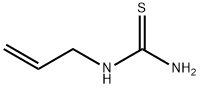
| Chemical Properties | white crystals or powder | | Uses | chelating agent | | Uses | N-Allylthiourea is a nitrification inhibitor used in the study on the transformation of diclofenac, naproxen and bisoprolol under aerobic and anaerobic conditions. It is also used in medicine to minimize scar tissue in order to fight against a type of dermatitis. Further, it inhibits the growth of transplanted tumors in mice. It acts as a chelating agent. In addition, it is used in cosmetics, preservative and in organic synthesis. | | Definition | ChEBI: A thiourea with a prop-2-enyl group attached to one of the amines. | | General Description | White crystalline solid with a slight garlic odor. | | Air & Water Reactions | Soluble in water. | | Reactivity Profile | Allylthiourea may react vigorously with strong oxidizing agents. Can react exothermically with reducing agents (such as alkali metals and hydrides) to release gaseous hydrogen. May react exothermically with both acids and bases. May generate flammable gases in combination with aldehydes, nitrides, and hydrides. Incompatible with peroxides and acid halides. | | Health Hazard | SYMPTOMS: Contact eczema due to sensitization in humans has been reported. | | Fire Hazard | Flash point data are not available for Allylthiourea, but Allylthiourea is probably combustible. | | Biochem/physiol Actions | N-Allylthiourea inhibits the growth of transplanted tumours in mice. | | Purification Methods | Recrystallise it from H2O. It is soluble in 30 parts of cold H2O, and it is soluble in EtOH but insoluble in *C6H6. It has also been recrystallised from acetone, EtOH or ethyl acetate, after decolorising with charcoal. The white crystals have a bitter taste with a slight garlic odour and are TOXIC. An unstable crystalline form is obtained by recrystallising from the melt. [McCrone et al. Anal Chem 21 421 1949, Beilstein 4 IV 1072.] |
| Allylthiourea Preparation Products And Raw materials |
|


 日本语
日本语 한국어
한국어 Français
 Deutsch
 España
 Türkiye