| Uses | The dihydrate is a mordant in dyeing and printing fabrics; used in preparing aniline black; a colorant in ceramics to form blue and green glazes; used in making colored glass; and a reducing agent.
|
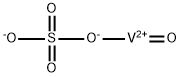
| Preparation | Vanadyl sulfate is prepared by passing sulfur dioxide through a cold solution of vanadium pentoxide in sulfuric acid, followed by crystallization:
V2O5 + H2SO4 + H2O + SO2 → 2VOSO4 + 2H2O
|
| Chemical Properties | Vanadyl sulfate is a pale blue crystalline powder.
Odorless. |
| Physical properties | The dihydrate, VOSO4?2H2O is a blue black crystalline powder, soluble in water. |
| General Description | A blue crystalline solid. Very soluble in water. Denser than water. Contact may irritate skin, eyes, and mucous membranes. May be toxic by ingestion, inhalation and skin absorption. |
| Reactivity Profile | Vanadyl sulfate has weak oxidizing or reducing powers. Redox reactions can however still occur. |
| Health Hazard | Highly toxic, may be fatal if inhaled, swallowed or absorbed through skin. Avoid any skin contact. Effects of contact or inhalation may be delayed. Fire may produce irritating, corrosive and/or toxic gases. Runoff from fire control or dilution water may be corrosive and/or toxic and cause pollution. |
| Fire Hazard | Non-combustible, substance itself does not burn but may decompose upon heating to produce corrosive and/or toxic fumes. Containers may explode when heated. Runoff may pollute waterways. |
| Flammability and Explosibility | Nonflammable |
| Safety Profile | A poison and an
inhalation hazard. Poison by intravenous,
intraperitoneal, and subcutaneous routes.
Mutation data reported. When heated to
decomposition it emits toxic fumes of VOx
and SOx. See also SULFATES and
VANADIUM COMPOUNDS. |
| Potential Exposure | Vanadyl sulfate is used as a fixative
for textile dyes, a colorant for glass and ceramics; a reducing
agent and a catalyst. |
| Veterinary Drugs and Treatments |
| Shipping | UN2931 Vanadyl sulfate, Hazard Class: 6.1;
Labels: 6.1-Poisonous materials. |
| Incompatibilities | Vanadyl sulfate has weak oxidizing or
reducing powers. Redox reactions can however still
occur. Incompatible with oxidizers (chlorates, nitrates,
peroxides, permanganates, perchlorates, chlorine, bromine,
fluorine, etc.); contact may cause fires or explosions. Keep
away from alkaline materials, strong bases, strong acids,
oxoacids, epoxides. Vanadyl sulfate may attack metals; sulfates
react with aluminum, magnesium. |

 日本语
日本语 한국어
한국어 Français
 Deutsch
 España
 Türkiye