Other grades of this product :
| Triasulfuron Basic information |
| Triasulfuron Chemical Properties |
| Melting point | 178°C | | density | 1.5218 (rough estimate) | | vapor pressure | 0Pa at 25℃ | | refractive index | 1.5630 (estimate) | | storage temp. | 0-6°C | | form | neat | | BRN | 7151883 | | LogP | 1.6-2.6 at 25℃ and pH5-9 | | Dissociation constant | 4.64 at 20℃ | | CAS DataBase Reference | 82097-50-5(CAS DataBase Reference) | | EPA Substance Registry System | Triasulfuron (82097-50-5) |
| Hazard Codes | N | | Risk Statements | 50/53 | | Safety Statements | 60-61 | | RIDADR | UN3077 9/PG 3 | | WGK Germany | 2 | | RTECS | DB1554000 | | HS Code | 29350090 | | Hazardous Substances Data | 82097-50-5(Hazardous Substances Data) | | Toxicity | LD50 in rats (mg/kg): >5000 orally; >2000 dermally; LC50 (4 hr) in rats: >5185 mg/m3 by inhalation (Amrein, Gerber) |
| Triasulfuron Usage And Synthesis |
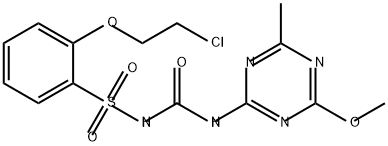
| Uses | Herbicide. | | Definition | ChEBI: An N-sulfonylurea that is N-[o-(2-chloroethoxy)phenyl]sulfonylurea in which one of the hydrogens attached to the non-sulfonylated nitrogen has been replaced by a 4-methoxy-6-methyl-1,3,5-triazin-2-yl group
A herbicide used to control broad-leaved weeds in cereals, its use within the EU has been banned after September 2017 on the grounds of potential groundwater contamination and risks to aquatic life. | | Agricultural Uses | Herbicide: Used for the control of annual ryegrass, paradoxa
grass and a wide range of broadleaf weeds in wheat and the
post-emergence control of wild radishes in wheat, oats and
barley. Registered for use in EU countries
. Registered
for use in the U.S | | Trade name | AMBER®; CGA 131036®; LOGRAN®;
RAVE® | | Metabolic pathway | Triasulfuron undergoes hydrolytic degradation,
especially under acidic conditions, giving rise to
cleavage of the sulfonylurea linkage, producing the
major products 2-(2-chloroethoxy)benzenesulfonamide
and 4-methyl-6-methoxy-2-amino-1,3,5-triazine and the
minor product acetyltriuret. In plants, hydroxylation
occurs at the 5-position of the phenyl ring to yield 5-
hydroxytriasulfuron as a primary metabolite which is a
major metabolite from the plant microsomal system.By mammals, orally administered triasulfuron is mainly
excreted in the urine, and O-dealkylation of 2-
chloroethoxy and 6-methoxy groups, and hydroxylation
at the 5-position of the phenyl ring and at the 4-methyl
group of the triazine ring are observed. By UV
irradiation, 2-chloroethoxybenzene is interestingly
identified with (4-methoxyl-6-methyl-1,3,5-triazine)urea,
and, in sunlight, with these two products, 2-amino-4-
methoxyl-6-methyltriazine and 2-(2-
chloroethoxy)benzenesulfonamide are identified. |
| Triasulfuron Preparation Products And Raw materials |
|


 日本语
日本语 한국어
한국어 Français
 Deutsch
 España
 Türkiye