Other grades of this product :
| Diphenyl phosphate Basic information |
| Diphenyl phosphate Chemical Properties |
| Melting point | 62-66 °C (lit.) | | Boiling point | 280°C | | density | 0,76 g/cm3 | | refractive index | 1.6250 | | Fp | 4°C | | storage temp. | Inert atmosphere,Room Temperature | | solubility | Chloroform (Slightly), Methanol (Slightly) | | pka | 1.12±0.50(Predicted) | | form | Crystalline Powder | | color | White | | Water Solubility | Soluble in benzene. Insoluble in water. | | BRN | 1379164 | | InChIKey | ASMQGLCHMVWBQR-UHFFFAOYSA-N | | CAS DataBase Reference | 838-85-7(CAS DataBase Reference) | | EPA Substance Registry System | Diphenyl phosphate (838-85-7) |
| Risk Statements | 36/37/38 | | Safety Statements | 22-24/25 | | WGK Germany | 3 | | RTECS | TC5470000 | | TSCA | Yes | | HS Code | 29190090 |
| Diphenyl phosphate Usage And Synthesis |
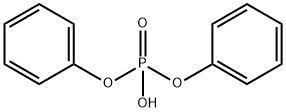
| Chemical Properties | white crystalline powder | | Uses | Diphenyl Phosphate is an organophosphate diester and metabolite of the flame retardant Triphenyl Phosphate (T808990) and also a metabolite of 2-Ethylhexyl diphenyl phosphate. | | Uses | Diphenyl phosphate can be used as an organic catalyst for the ring-opening polymerization (ROP) of renewable 5-alkyl δ-lactones. In combination with zinc iodide, it forms a novel initiating system for the living cationic polymerization of isobutyl vinyl ether. | | Purification Methods | Crystallise it from CHCl3/pet ether. [Cherbuliez in Organo Phosphorus Compounds (Kosolapoff & Maier eds) Wiley Vol 6 pp 211-577 1973, Beilstein 6 IV 714.] |
| Diphenyl phosphate Preparation Products And Raw materials |
|


 日本语
日本语 한국어
한국어 Français
 Deutsch
 España
 Türkiye