Other grades of this product :
| Cynaroside Basic information | | Effects |
| Cynaroside Chemical Properties |
| Melting point | 256~258℃ | | storage temp. | Sealed in dry,2-8°C | | solubility | DMSO (Slightly), Methanol (Slightly) | | Boiling point | 838.1±65.0 °C(Predicted) | | density | 1.713±0.06 g/cm3(Predicted) | | pKa | 6.10±0.40(Predicted) | | form | neat | | color | Yellow to Very Dark Yellow | | Stability: | Hygroscopic | | InChIKey | PEFNSGRTCBGNAN-QNDFHXLGSA-N | | CAS DataBase Reference | 5373-11-5(CAS DataBase Reference) |
| Hazard Codes | Xi | | Safety Statements | 24/25 | | WGK Germany | 3 | | RTECS | DJ3009400 | | HS Code | 29389090 |
| Cynaroside Usage And Synthesis |
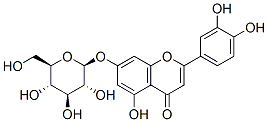
| Effects | Luteolin has a strong bactericidal effect on the respiratory tract, and it is the main active ingredient in the treatment of bronchitis in Qinglan, a unique medicinal material in Xinjiang. Lowers the role of cholesterol in atherosclerosis and enhances capillary relaxation. | | Description | Luteolin-7-O-glucoside is a flavonoid that has been found in many Chinese herbs with diverse biological activities. It reduces lactate dehydrogenase (LDH) and caspase-3 activities and production of reactive oxygen species (ROS) and increases cell viability and 14-3-3η protein levels in H9C2 cardiomyocytes after anoxia/reoxygenation injury. Luteoloside blocks 3C protease activity (IC50 = 0.36 mM) and reduces the cytopathic effect of enterovirus 71 in rhabdomyosarcoma cells (EC50 = 0.43 mM). It inhibits the growth of hepatocellular carcinoma (HCC) cells in vitro via reduction in ROS accumulation, caspase-1 activity, and expression of the NLRP3 inflammasome and reduces the number of lung metastases in an SMMC-7721 HCC mouse xenograft model when administered at a dose of 2 mg/kg. Luteoloside also reduces acanthosis and expression of epidermal differentiation markers in a mouse model of psoriasis induced by imiquimod . | | Chemical Properties | Off-white powder | | Uses | Luteolin 7-Glucoside is a strong antioxidant ant radical scavenger. Used in cancer prevention. | | Definition | ChEBI: A glycosyloxyflavone that is luteolin substituted by a beta-D-glucopyranosyl moiety at position 7 via a glycosidic linkage. |
| Cynaroside Preparation Products And Raw materials |
|


 日本语
日本语 한국어
한국어 Français
 Deutsch
 España
 Türkiye