Other grades of this product :
| Pepstatin Basic information |
| Pepstatin Chemical Properties |
| Melting point | 233 °C (dec.)(lit.) | | alpha | D27 -90.3° (c = 0.288 in methanol) | | Boiling point | 695.91°C (rough estimate) | | density | 1.1340 (rough estimate) | | refractive index | 1.7500 (estimate) | | storage temp. | 2-8°C | | solubility | 10% acetic acid in methanol: 1 mg/mL | | form | White solid | | pka | 4.17±0.10(Predicted) | | color | Colorless needles | | optical activity | Optical rotation: -90.0 ± 5° (c = 0.5, MeOH, 20°C). | | Water Solubility | It is soluble in 10% (v/v) acetic acid in methanol (9:1 methanol:acetic acid) (1 mg/ml), ethanol (1-2 mg/ml with heat up to 60°C), DMSO (5 mg/ml), methanol (1 mg/ml), and acetic acid. Insoluble in benzene, chloroform, water, 1 M NaOH, and ether. | | BRN | 2201362 | | Stability: | Stable. Incompatible with strong bases, strong acids. | | InChIKey | JKGWASGTXVCDML-LXTPJMTPSA-N | | CAS DataBase Reference | 26305-03-3(CAS DataBase Reference) |
| Safety Statements | 22-24/25 | | WGK Germany | 2 | | RTECS | SC6155000 | | F | 10 | | HS Code | 29241990 | | Toxicity | LD50 in mice, rats, rabbits, dogs (mg/kg): 1090, 875, 820, 450 i.p.; all >2000 orally (Umezawa, 1970) |
| Pepstatin Usage And Synthesis |
| Description | Pepstatin A is a bacterial-derived chemotactic pentapeptide that irreversibly inhibits aspartic proteases, including pepsin, gastricsin, renin, cathepsin E, and cathepsin D. Pepstatin A has been reported to stimulate human neutrophil degranulation (EC50 = 0.75 μM) and super oxide production (EC50 = 1.5 μM). Pepstatin A has been widely used as a research tool in studies of protease mechanisms and biological functions and has been examined as a therapeutic agent for inflammatory conditions including gastric ulcer, edema, and hypertension. | | Chemical Properties | solid | | Uses | Antiviral;Aspartic proteases irreversible inhibitor | | Uses | As an aspartic proteases irreversible inhibitor, Pepstain A can be used in conjunction with E64-d and Leupeptin A to inhibit the degradation of autophagic cargo inside autophagosomes.
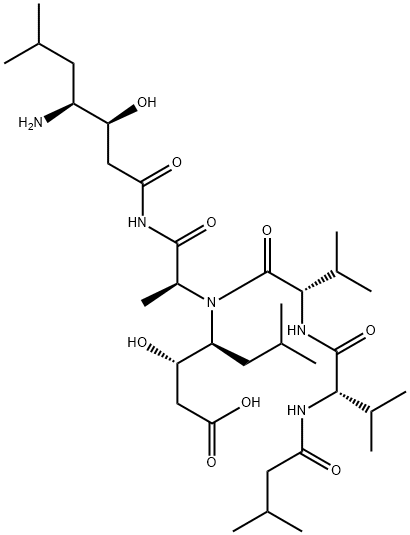
| | Uses | Pepstatin A are natural, statine-containing peptides that acts as inhibitor of aspartic protease enzymes. | | General Description | Pepstatin A is a naturally occurring chemotactic peptide and inhibitor of aspartic proteases that was initially isolated from culture filtrates of various Actinomycetes species, with the initial name simply of “pepstatin”. This name was later modified to “pepstatin A” to distinguish the original pepstatin from later derivatives. Pepstatin A notably contains the unusual amino acid 4-amino-hydroxy-6-methylheptanoic acid (AHMHA), which is known also as statine. The amino acid sequence of pepstatin A is N-Isovaleryl-L-Valyl-L-Valyl-AHMHA-L-Alanyl-AHMHA. | | Biochem/physiol Actions | Primary Targetaspartic proteases | | Safety Profile | Moderately toxic by intraperitoneal route. When heated to decomposition it emits toxic fumes of NOx. | | Enzyme inhibitor | This naturally occurring statine-containing peptidomimetic (FWfree-acid = 685.90 g/mol; CAS 26305-03-3), also called pepstatin A and isovalerylpepstatin and named systematically as N-(isovaleryl)-L-valyl-L-valyl-statylL-alanyl-statine (where the statyl residue is a (3S,4S)-4-amino-3-hydroxy-6- methylheptanoyl residue and the C-terminal statine is the corresponding acid), is a presumptive transition-state analogue for prototypical aspartate proteinase pepsin (Ki = 46 pM). Pepstatin will also inhibit other carboxy proteinases. The inhibitory effectiveness of statine-containing peptides has been widely exploited by incorporating the statine residue into peptides that otherwise match sequence preferences of the target enzyme’s sub-sites. Because pepstatin has a low solubility in water, it is often dissolved indimethyl sulfoxide, methanol, or ethanol. Note that many derivatives of pepstatin are available, each displaying a different spectrum of inhibitory effects. Pepstatin B and C are the N-(n-caproyl)- and N-(iso-caproyl)- derivatives, respectively. Note: Above a critical concentration of 0.1 mM in low ionic-strength and neutral buffers, pepstatin often polymerizes into filaments that be several micrometers in length and have characteristic diameters ranging between 6 and 12 nm | | References | 1) Merck Index 14:7147
2) Marciniszyn?et al.?(1976)?Mode of inhibition of acid proteases by pepstatin; J. Biol. Chem.,?251?7088
3) Oda (2012)?New families of carboxy peptidases: serine-carboxyl peptidases and glutamic peptidases; J. Biochem.,?151?13
4) Yoshida?et al. (2006)?Pepstatin A, an aspartic proteinase inhibitor, suppresses RANKL-induced osteoclast differentiation; J. Biochem.,?139?583 |
| Pepstatin Preparation Products And Raw materials |
|


 日本语
日本语 한국어
한국어 Français
 Deutsch
 España
 Türkiye