Other grades of this product :
| Octanoic acid Basic information |
| Octanoic acid Chemical Properties |
| Melting point | 16 °C | | Boiling point | 237 °C(lit.) | | density | 0.91 g/mL at 25 °C(lit.) | | vapor density | 5 (vs air) | | vapor pressure | 1 mm Hg ( 78 °C) | | refractive index | n20/D 1.428(lit.) | | FEMA | 2799 | OCTANOIC ACID | | Fp | >230 °F | | storage temp. | 20-25°C | | solubility | 0.68g/l | | pka | 4.89(at 25℃) | | form | Liquid | | Specific Gravity | 0.910 (20/4℃) | | color | Clear colorless to yellow | | PH | 3.97(1 mM solution);3.45(10 mM solution);2.95(100 mM solution); | | Odor | unpleasant odor | | PH Range | 3.5 | | explosive limit | 1%(V) | | Water Solubility | 0.68 g/L (20 ºC) | | Merck | 14,1765 | | JECFA Number | 99 | | BRN | 1747180 | | Stability: | Stable. Incompatible with bases, reducing agents, oxidizing agents. Flammable. | | LogP | 3.05 at 20℃ | | CAS DataBase Reference | 124-07-2(CAS DataBase Reference) | | NIST Chemistry Reference | Octanoic acid(124-07-2) | | EPA Substance Registry System | Octanoic acid (124-07-2) |
| Hazard Codes | C,Xi | | Risk Statements | 34 | | Safety Statements | 26-36/39-45-36/37/39-25-27 | | RIDADR | UN 3265 8/PG 3 | | WGK Germany | 1 | | RTECS | RH0175000 | | Autoignition Temperature | >300 °C | | Hazard Note | Irritant | | TSCA | Yes | | HS Code | 2915 90 70 | | HazardClass | 8 | | PackingGroup | III | | Hazardous Substances Data | 124-07-2(Hazardous Substances Data) | | Toxicity | LD50 orally in rats: 10,080 mg/kg (Jenner) |
| Octanoic acid Usage And Synthesis |
| Description | Caprylic acid is the common name for the eight-carbon saturated fatty acid known by the systematic name octanoic acid. It is found naturally in the milk of various mammals, and it is a minor constituent of coconut oil and palm kernel oil. It is an oily liquid that is minimally soluble in water with a slightly unpleasant rancid-like smell and taste. Two other acids are named after goats: caproic (C6) and capric (C10). Along with caprylic acid these total 15 % in goat milk fat. | | Chemical Properties | Octanoic acid has a mildly unpleasant odor and a burning, rancid taste. Octanoic acid is also reported as having a faint,
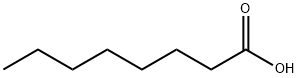
fruity–acid odor and slightly sour taste. Caprylic acid is the common name for octanoic acid, CH3(CH2)6COOH, a saturated fatty
acid. As an eight-carbon compound, it is among the fatty acids considered to be of short or medium chain length. | | Physical properties | Caprylic acid, CH3(CH2)6COOH, also known as hexylacetic acid,n-octanoic acid, octylie acid, and octic acid, is a colorless, oily liquid having a mildly unpleasant odor and a burning, rancid taste. It is only slightly soluble in water (68 mg per 100 mL at 20°C). It is a natural component of coconut and palm nut oils and butter fat. Caprylic acid has also been identified in trace amounts in beer, brandy distillate, the essential oil of fermented Russian black tea leaves, and raw soybeans.It is used in manufacturing drugs and dyes. | | Occurrence | Octanoic acid is found naturally in the milk of various mammals and is a natural component of coconut and palm nut oils and butter fat. Caprylic acid has also been identified in trace amounts in beer, brandy distillate, the essential oil of fermented Russian black tea leaves and raw soybeans. Reported as occurring naturally in the essential oils of Cupressus torulosa, Cryptomeria japonica, Andropogon iwarancusa, Cymbopogon javanensis, camphor, nutmeg, lemongrass, lime, tobacco (flowers), Artemisia herba-alba, chamomile, hops and others; also reported in apple aroma, coconut oil as glyceride, and wine as an ester; it has been identified (free and esterified) among the constituents of petitgrain lemon oil. | | Uses | Octanoic acid is a flavoring agent considered to be a short or medium chain fatty acid. It occurs normally in various foods and is commercially prepared by oxidation of n-octanol or by fermentation and fractional distillation of the volatile fatty acids present. It is used in maximum levels, as served, of 0.13% for baked goods; 0.04% for cheeses; 0.005% for fats and oils, frozen dairy desserts, gelatins and puddings, meat products, and soft candy; 0.016% for snack foods; and 0.001% or less for all other food categories. | | Definition | ChEBI: Octanoic acid is a straight-chain saturated fatty acid that is heptane in which one of the hydrogens of a terminal methyl group has been replaced by a carboxy group. Octanoic acid is also known as caprylic acid. It has a role as an antibacterial agent, a human metabolite and an Escherichia coli metabolite. It is a straight-chain saturated fatty acid and a medium-chain fatty acid. It is a conjugate acid of an octanoate. | | Application | Octanoic acid is widely applied in various fields, It is an antimicrobial pesticide used as a food contact surface sanitizer in commercial food handling establishments on dairy equipment, food processing equipment, breweries, wineries, and beverage processing plants. In addition, caprylic acid is used as an algaecide, bactericide, and fungicide in nurseries, greenhouses, garden centers, and interiorscapes on ornamentals. Products containing caprylic acid are formulated as soluble concentrate/liquids and ready-to-use liquids.Caprylic acid is also used in the treatment of some bacterial infections. Due to its relatively short chain length it has no difficulty in penetrating fatty cell wall membranes, hence its effectiveness in combating certain lipid-coated bacteria, such as Staphylococcus aureus and various species of Streptococcus.Octanoic acid is used commercially in the production of esters used in perfumery and also in the manufacture of dyes.Some studies have shown that Caprylic acid is effective to excess calorie burning taken as a dietary supplement, resulting in weigh loss. | | Preparation | Octanoic acid is produced by fermentation and fractional distillation of the volatile fatty acids present in coconut oil. | | Aroma threshold values | Detection: 910 ppb to 19 ppm. Aroma characteristics at 1.0%: waxy, dirty, sweaty and cheesy fatty, with
dirty oily and creamy dairy nuances. | | Taste threshold values | Taste characteristics at 10 ppm: creamy, waxy, dirty, sweaty, dairy cheeselike. | | Synthesis Reference(s) | The Journal of Organic Chemistry, 54, p. 5395, 1989 DOI: 10.1021/jo00283a044Synthetic Communications, 19, p. 2151, 1989 DOI: 10.1080/00397918908052610 | | General Description | Octanoic acid appears as a colorless to light yellow liquid with a mild odor. Burns, but may be difficult to ignite. Corrosive to metals and tissue. | | Flammability and Explosibility | Notclassified | | Safety Profile | Moderately toxic by
intravenous route. Mildly toxic by ingestion.
Mutation data reported. A skin irritant.
Yields irritating vapors that can cause
coughmg. When heated to decomposition it
emits acrid smoke and irritating fumes. |
| Octanoic acid Preparation Products And Raw materials |
|

 日本语
日本语 한국어
한국어 Français
 Deutsch
 España
 Türkiye