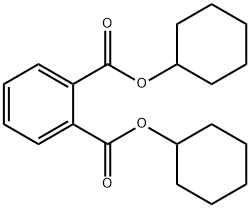
| Dicyclohexyl phthalate Basic information |
| Product Name: | Dicyclohexyl phthalate |
| Synonyms: | howflexcp;KP 201;kp201;Morflex 150;phtalatededicyclohexyle;Unimoll 66;Unimoll 66 M;unimoll66 |
| CAS: | 84-61-7 |
| MF: | C20H26O4 |
| MW: | 330.42 |
| EINECS: | 201-545-9 |
| Product Categories: | Plasticizers;Polymer Additives;Analytical Chemistry;Environmental Endocrine Disruptors;Functional Materials;Polymer Science;Phthalates (Environmental Endocrine Disruptors);Phthalates (Plasticizer);Plasticizer;EstersCosmetics;PhthalatesAnalytical Standards;PlasticizersMethod Specific;2000/60/ECMore...Close...;Allergens;Alpha Sort;Analytical Standards;AromaticsVolatiles/ Semivolatiles;Chemical Class;D;DAlphabetic;DIA - DICAnalytical Standards;European Community: ISO and DIN |
| Mol File: | 84-61-7.mol |
| Dicyclohexyl phthalate Chemical Properties |
| Melting point | 63-67 °C(lit.) |
| Boiling point | 200-235 °C (4 mmHg) |
| density | 1.2 |
| vapor density | 11.6 (vs air) |
| vapor pressure | 0.1 mm Hg ( 150 °C) |
| refractive index | 1.485 |
| Fp | 207 °C |
| storage temp. | Store below +30°C. |
| solubility | 0.2mg/l |
| form | Solid |
| color | White |
| Water Solubility | insoluble |
| BRN | 1889288 |
| InChIKey | VOWAEIGWURALJQ-UHFFFAOYSA-N |
| LogP | 4.82 at 25℃ |
| CAS DataBase Reference | 84-61-7(CAS DataBase Reference) |
| NIST Chemistry Reference | 1,2-Benzenedicarboxylic acid, dicyclohexyl ester(84-61-7) |
| EPA Substance Registry System | Dicyclohexyl phthalate (84-61-7) |
| Safety Information |
| Hazard Codes | Xi |
| Risk Statements | 36/37/38 |
| Safety Statements | 26-36 |
| WGK Germany | 1 |
| RTECS | TI0889000 |
| TSCA | Yes |
| HS Code | 29173400 |
| Hazardous Substances Data | 84-61-7(Hazardous Substances Data) |
| Toxicity | LD50 oral in rat: 30mL/kg |
| MSDS Information |
| Provider | Language |
|---|---|
| Dicyclohexyl phthalate | English |
| SigmaAldrich | English |
| ACROS | English |
| Dicyclohexyl phthalate Usage And Synthesis |
| Chemical Properties | white crystalline powder |
| Uses | Dicyclohexyl Phthalate is a phthalate ester used as a plasticizer as well as being present in cosmetic products. Dicyclohexyl Phthalate that is a weak drug-type inducer of hepatic xenobiotic metabolis m. |
| Uses | Dicyclohexyl Phthalate is a phthalate ester used as a plasticizer as well as being present in cosmetic products. Dicyclohexyl Phthalate that is a weak drug-type inducer of hepatic xenobiotic metabolism. |
| Uses | DCHP modified multi-walled carbon nanotubes (MWCNTs) may be used to functionalize screen printed electrodes in biosensor based applications. It may also be used as a reference standard for the determination of dicyclohexyl phthalate in aquatic matrices by ultra-high performance liquid chromatography coupled to hybrid Q-orbitrap mass spectrometry(UHPLC-HRMS). |
| General Description | White granular solid with an aromatic odor. Water insoluble. |
| Air & Water Reactions | Insoluble in water. |
| Reactivity Profile | Dicyclohexyl phthalate is an ester. Esters react with acids to liberate heat along with alcohols and acids. Strong oxidizing acids may cause a vigorous reaction that is sufficiently exothermic to ignite the reaction products. Heat is also generated by the interaction of esters with caustic solutions. Flammable hydrogen is generated by mixing esters with alkali metals and hydrides. Dicyclohexyl phthalate reacts with oxidizers. Dicyclohexyl phthalate hydrolyzes under acid and basic conditions. |
| Health Hazard | ACUTE/CHRONIC HAZARDS: Dicyclohexyl phthalate may cause irritation on contact. |
| Fire Hazard | Dicyclohexyl phthalate is combustible. |
| Flammability and Explosibility | Notclassified |
| Dicyclohexyl phthalate Preparation Products And Raw materials |
| Raw materials | Phthalic anhydride-->Cyclohexanol |
Please leave a message for us or use the following ways to contact us, we will reply to you as soon as possible, and provide you with the most sincere service, thank you.


 日本语
日本语 한국어
한국어 Français
 Deutsch
 España
 Türkiye