| Chemical Properties | 2-Methylbutane (isopentane), C5H12, is a flammable liquid and exhibits physical properties very similar to those of pentane. It has been detected in urban air.
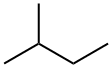
2-Methylbutane is an alkane that is butane substituted by a methyl group at position 2. It has a higher BP than butane because, although similarly branched, it has a higher MW. A useful analogy for comparing molecules with the same size of longest chain is that of cylindrical-shaped molecules. It has a role as a refrigerant. Biological samples flash frozen for example with a combination of liquid nitrogen and methylbutane can then be used for storage, cryosection, etc. |
| Physical properties | Clear, colorless, watery, very flammable liquid with a pleasant odor. Evaporates quickly when
spilled. An odor threshold concentration of 1.3 ppmv was reported by Nagata and Takeuchi
(1990). |
| Uses | Isopentane is an organic, branched-chain alkane with five carbon atoms. 2-Methylbutane undergoes catalytic dehydrogenation in the presence of chromia-alumina catalyst to form isoamylenes, which can undergo further dehydrogenation to form isoprene. It may also be used as a solvent in the preparation of trans-Bis(triethylphosphine) (hydroxy carbonyl) (phenyl) platinum(II), a metallacarboxylic acid. |
| Uses | 2-Methylbutane is used as a chemical intermediate. It acts as a blowing agent for polystyrene and gasoline additive. It is used as a solvent of polyethylene and involved in the preparation of polystyrene foam and polyurethane foam. Further, it is used in a closed loop in geothermal power production to operate turbines. In addition to this, it is used to freeze biological samples like tissues in place of dry ice for cryosectioning in histology. |
| Preparation | 2-Methylbutane was synthesized by liquid-phase catalytic isomerization at 95°C using pentane as raw material. |
| Production Methods | Isopentane is produced by fractional distillation of natural
gas liquids and crude oil. |
| Definition | ChEBI: 2-methylbutane is an alkane that is butane substituted by a methyl group at position 2. It has a role as a refrigerant. |
| General Description | Watery colorless liquid with a gasoline-like odor. Floats on water. Flammable, irritating vapor is produced. Boiling point is 82°F. |
| Air & Water Reactions | Highly flammable. Insoluble in water. |
| Reactivity Profile | 2-Methylbutane is a fire and explosion hazard when in contact with oxidizing agents. . |
| Health Hazard | Inhalation causes irritation of respiratory tract, cough, mild depression, irregular heartbeat. Aspiration causes severe lung irritation, coughing, pulmonary edema; excitement followed by depression. Ingestion causes nausea, vomiting, swelling of abdomen, headache, depression. |
| Fire Hazard | Behavior in Fire: Highly volatile liquid. Vapors may explode when mixed with air. |
| Flammability and Explosibility | Extremelyflammable |
| Safety Profile | Mddly toxic and
narcotic by inhalation. See also PENTANE.
Flammable liquid. A very dangerous fire and
explosion hazard when exposed to heat,
flame, or oxidzers. Keep away from sparks,
heat, or open flame; can react with oxidizing
materials. To fight fire, use foam, CO2, dry
chemical. When heated to decomposition it
emits acrid smoke and irritating fumes.
|
| Source | A constituent in gasoline. Harley et al. (2000) analyzed the headspace vapors of three
grades of unleaded gasoline where ethanol was added to replace methyl tert-butyl ether. The
gasoline vapor concentrations of 2-methylbutane in the headspace were 24.1 wt % for regular
grade, 24.8 wt % for mid-grade, and 26.0 wt % for premium grade.
Schauer et al. (2001) measured organic compound emission rates for volatile organic
compounds, gas-phase semi-volatile organic compounds, and particle-phase organic compounds
from the residential (fireplace) combustion of pine, oak, and eucalyptus. The gas-phase emission
rate of 2-methylbutane was 5.6 mg/kg of pine burned. Emission rates of 2-methylbutane were not
measured during the combustion of oak and eucalyptus.
California Phase II reformulated gasoline contained 2-methylbutane at a concentration of 79.2g/kg. Gas-phase tailpipe emission rates from gasoline-powered automobiles with and without
catalytic converters were 3.69 and 148 μg/km, respectively (Schauer et al., 2002). |
| Environmental fate | Photolytic. When synthetic air containing gaseous nitrous acid and 2-methylbutane was exposed
to artificial sunlight (λ = 300–450 nm), acetone, acetaldehyde, methyl nitrate, peroxy-acetal
nitrate, propyl nitrate, and pentyl nitrate were formed (Cox et al., 1980).
Based upon a photooxidation rate constant of 3.90 x 10⁻¹² cm3/molecule?sec with OH radicals in
summer daylight, the atmospheric lifetime is 36 h (Altshuller, 1991). At atmospheric pressure and
300 K, Darnall et al. (1978) reported a rate constant of 3.78 x 10⁻¹² cm3/molecule?sec for the same
reaction.
Cox et al. (1980) reported a rate constant of 5.0 x 10⁻¹¹ cm3/molecule?sec for the reaction of
gaseous 2-methylbutane with OH radicals based on a value of 8 x 10-12 cm3/molecule?sec for the
reaction of ethylene with OH radicals.Chemical/Physical. Complete combustion in air produces carbon dioxide and water vapor.
2-Methylbutane will not hydrolyze because it does not contain a hydrolyzable functional group. |
| Purification Methods | Stir isopentane for several hours in the cold with conc H2SO4 (to remove olefinic impurities), then wash it with H2O, aqueous Na2CO3 and H2O again. Dry it with MgSO4 and fractionally distil it using a Todd column packed with glass helices. Material transparent down to 180nm is obtained by distilling from sodium wire, and passing through a column of silica gel which had previously been dried in place at 350o for 12hours before use. [Potts J Phys Chem 20 809 1952, Beilstein 1 IV 320.] |


 日本语
日本语 한국어
한국어 Français
 Deutsch
 España
 Türkiye