Other grades of this product :
| 2,6-Diethylaniline Basic information |
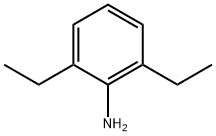
| Product Name: | 2,6-Diethylaniline | | Synonyms: | 2,6-Diethylaniline,2-Amino-1,3-diethylbenzene;2,6-Diethylaniline, 98% 1LT;2,6-diethyl-anilin;2,6-diethyl-benzenamin;2,6-Diethylbenzenamine;2,6-diethyl-Benzenamine;DEA) 2,6-Diethy;2,6- twoethyl aniline | | CAS: | 579-66-8 | | MF: | C10H15N | | MW: | 149.23 | | EINECS: | 209-445-7 | | Product Categories: | Organics;Aniline Derivatives;Intermediates of Dyes and Pigments;o-alkylated Anilines | | Mol File: | 579-66-8.mol |
| 2,6-Diethylaniline Chemical Properties |
| Melting point | 3-4 °C | | Boiling point | 243 °C (lit.) | | density | 0.906 g/mL at 25 °C (lit.) | | vapor pressure | 0.02 mm Hg ( 20 °C) | | refractive index | n20/D 1.545(lit.) | | Fp | 254 °F | | storage temp. | Keep in dark place,Inert atmosphere,Room temperature | | solubility | Chloroform (Slightly), Methanol (Slightly) | | pka | 4.13±0.10(Predicted) | | form | Liquid | | color | Clear yellow to reddish-brown | | Water Solubility | 0.67g/L(26.7 ºC) | | Sensitive | Air Sensitive | | BRN | 1423626 | | Stability: | Air Sensitive | | CAS DataBase Reference | 579-66-8(CAS DataBase Reference) | | NIST Chemistry Reference | Benzenamine, 2,6-diethyl-(579-66-8) | | EPA Substance Registry System | 2,6-Diethylaniline (579-66-8) |
| 2,6-Diethylaniline Usage And Synthesis |
| Chemical Properties | Clear liquid | | Uses | 2,6-Diethylaniline is an intermediate for the production of alachlor, butachlor, metolachlor-herbicides, tiafentiurone-insecticide, carbodiimide and RIM-PUR. Product Data Sheet | | Uses | 2,6-Diethylaniline is used as a reagent in the synthesis of herbicides, for instance Butachlor (B689925); a pre-emergent chloroacetanalide herbicide commonly used for weed control in rice as well as cotton, maize, wheat and other crops. | | Production Methods | 2,6-Diethylaniline is obtained in high yield when aniline is heated with ethylene at 200-300°C under high pressure in the presence of aluminum anilide (Northcott 1978). | | General Description | The 2,6-diethylaniline complexes with iodine, as a sigma-acceptor, were studied spectrophotometrically in chloroform, dichloromethane and carbontetrachloride solutions. | | Industrial uses | 2,6-Diethylaniline is used in the synthesis of herbicides such as Nevirex G and butachlor (Vertesi and Miklos 1982; Lee et al 1982). | | Metabolic pathway | Incubation of 2,6-diethylaniline (DEA) with NADPH-
fortified rat liver microsomal enzymes produces 4-
amino-3,5-diethylphenol (ADEP) as the major
oxidation product. ADEP is shown to undergo further
oxidation to 3,5-diethylbenzoquinone-4-imine (DEBQI),
which is isolated as a minor metabolite during DEA
oxidation. | | Metabolism | Incubation of 2,6-diethylaniline with NADPH-fortified microsomes produced 4-amino-3,5-diethylphenol (ADEP) as the major oxidation product (Feng and Wratten 1987). ADEP underwent further oxidation to 3,5-diethyl-benzoquinone-4-imine which is isolated as a minor metabolite during 2,6-diethylaniline metabolism. 2,6-Diethylaniline is produced under aerobic soil conditions as a minor metabolite of the herbicide butachlor (Lee et al 1982). 2,6-Diethylaniline is degraded by the soil microorganism Chaetomium globosum to 2,6-diethylacetanilide and 2,6-diethyl-p-benzoquinone (Lee and Ryu 1982). 2,6-Diethylaniline was also very persistent towards biodegradation in pond water with and without sewage sludge inoculation (Lyons et al 1985). |
| 2,6-Diethylaniline Preparation Products And Raw materials |
|


 日本语
日本语 한국어
한국어 Français
 Deutsch
 España
 Türkiye