Other grades of this product :
| 2-TERT-BUTYL-1,1,3,3-TETRAMETHYLGUANIDINE Basic information |
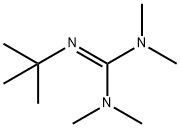
| Product Name: | 2-TERT-BUTYL-1,1,3,3-TETRAMETHYLGUANIDINE | | Synonyms: | 2-TERT-BUTYL-1,1,3,3-TETRAMETHYL-GUANIDI;2-TERT-BUTYL-1,1,3,3-TETRAMETHYLGUANIDINE;Guanidine, N''-(1,1-diMethylethyl)-N,N,N',N'-tetraMethyl-;2-tert-Butyl-1,1,3,3-tetraMethylguanidine >=97.0% (GC);BTMG;EOS-61801;N''-tert-butyl-N,N,N',N'-tetramethylguanidine;3H-Pyrazol-3-one,1,2-dihydro-1-(5-methylethyl)- | | CAS: | 29166-72-1 | | MF: | C9H21N3 | | MW: | 171.28 | | EINECS: | | Product Categories: | Guanidines;Nitrogen Compounds;Organic Building Blocks | | Mol File: | 29166-72-1.mol |
| 2-TERT-BUTYL-1,1,3,3-TETRAMETHYLGUANIDINE Chemical Properties |
| Boiling point | 88-89 °C/43 mmHg (lit.) | | density | 0.85 | | refractive index | n20/D 1.457 | | Fp | 65 °C | | storage temp. | under inert gas (nitrogen or Argon) at 2-8°C | | pka | 13.81±0.70(Predicted) | | form | clear liquid | | color | Colorless to Light yellow | | BRN | 2352408 | | InChIKey | YQHJFPFNGVDEDT-UHFFFAOYSA-N |
| 2-TERT-BUTYL-1,1,3,3-TETRAMETHYLGUANIDINE Usage And Synthesis |
| Preparation | To an ovendried, 500-mL, three-necked, round-bottomed flask, equipped with a nitrogen inlet with gas bubbler, magnetic stirring bar, thermometer, condenser, and a 250-mL dropping funnel, were added triphosgene (14.8 g, 0.05 mol) and anhydrous toluene (120 mL). The mixture was kept under argon and cooled to ca. 10 C° with the aid of an external ice bath. A solution of N,N,N,N-tetramethylurea (18.0 mL, 0.15 mol) in dry toluene (50 mL) was then slowly added over a period of 30 min. After completion of the addition, the mixture was allowed to warm to ambient temperature, and stirring was continued for a further 1 h. During this time, a white precipitate formed, consisting of the Vilsmeier salt. Then, tert-butylamine (47.3 mL, 0.45 mol) was slowly added to the mixture over a period of 30 min. After completion of the addition, the mixture was heated under reflux for 5 h and then cooled to room temperature. Anhydrous diethyl ether (200 mL) was added and the white precipitate was quickly removed by filtration. This precipitate had to be collected as quickly as possible to avoid hydrolysis to the starting urea. The precipitate turns pale-yellow if hydrolysis is occurring. In some instances, additional diethyl ether (300 mL) was needed to ensure complete transfer of the solids to the filtration apparatus. The precipitate was washed with a further quantity of anhydrous diethyl ether (300 mL) (the filtrate must be colorless, indicating that all impurities have been removed) and immediately dissolved in aqueous 25% sodium hydroxide solution (100 mL). The mixture was then extracted with diethyl ether (3 × 300 mL). The combined organic layers were dried (potassium carbonate), filtered, and the solvent was removed under reduced pressure. The resulting colorless liquid was purified by distillation (bp 88–89 C°/36 mmHg) to afford 18.7 g (73%) of 2-tertbutyl- 1,1,3,3-tetramethylguanidine 1779. | | General Description | 2-tert-Butyl-1,1,3,3-tetramethylguanidine (Barton′s base) is an excellent alternative to traditional inorganic bases for promoting the coupling reaction. |
| 2-TERT-BUTYL-1,1,3,3-TETRAMETHYLGUANIDINE Preparation Products And Raw materials |
|


 日本语
日本语 한국어
한국어 Français
 Deutsch
 España
 Türkiye