Other grades of this product :
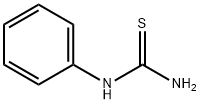
| 1-PHENYL-2-THIOUREA Basic information |
| 1-PHENYL-2-THIOUREA Chemical Properties |
| Melting point | 145-150 °C(lit.) | | Boiling point | 266.7±23.0 °C(Predicted) | | density | 1.3 | | refractive index | 1.5500 (estimate) | | storage temp. | Keep in dark place,Inert atmosphere,Room temperature | | solubility | Soluble in alcohol | | pka | 13.12±0.70(Predicted) | | form | Crystalline Powder | | color | Off-white to beige | | Water Solubility | Soluble in hot water and alcohol. | | Merck | 14,7315 | | BRN | 907309 | | Stability: | Stable. Incompatible with strong acids, strong oxidizing agents, strong bases. | | CAS DataBase Reference | 103-85-5(CAS DataBase Reference) | | EPA Substance Registry System | Phenylthiourea (103-85-5) |
| Hazard Codes | T+ | | Risk Statements | 28-43 | | Safety Statements | 28-36/37-45 | | RIDADR | UN 2811 6.1/PG 1 | | WGK Germany | 3 | | RTECS | YU1400000 | | TSCA | Yes | | HazardClass | 6.1 | | PackingGroup | I | | HS Code | 29309090 | | Hazardous Substances Data | 103-85-5(Hazardous Substances Data) | | Toxicity | LD50 in rats, rabbits (mg/kg): 3, 40 orally (Scheline) |
| 1-PHENYL-2-THIOUREA Usage And Synthesis |
| Chemical Properties | white crystalline powder | | Chemical Properties | N-phenylthiourea is a colorless crystalline solid. | | Uses | In medical genetics. | | Uses | 1-Phenylthiourea is used as a reactant in the preparation of disubstituted thiazoles as potential antibacterial and antiinflammatory agents via condensation of phenacyl bromide with thioureas and thiosemicarbazones. | | General Description | Needle-like crystals. Used in the manufacture of rodenticides and in medical genetics. | | Air & Water Reactions | Insoluble in water. | | Reactivity Profile | 1-PHENYL-2-THIOUREA is incompatible with strong oxidizers, strong acids and strong bases. 1-PHENYL-2-THIOUREA emits toxic fumes on contact with acid fumes. | | Health Hazard | 1-PHENYL-2-THIOUREA is classified as extremely toxic. The probable oral lethal dose is 5-50 mg/kg or between 7 drops and 1 teaspoon for a 70 kg (150 lb.) person. | | Fire Hazard | Dangerous disaster hazard; emits toxic fumes of oxides of sulfur and nitrogen when heated to decomposition. Avoid acids or acid fumes. | | Potential Exposure | Incompatible with oxidizers (chlorates, nitrates, peroxides, permanganates, perchlorates, chlorine, bromine, fluorine, etc.); contact may cause fires or explosions. Keep away from alkaline materials, strong bases, strong acids, oxoacids, epoxides. Contact with acids or acid fumes produces toxic fumes of sulfur oxide. | | Purification Methods | Crystallise the thiourea from water and dry it at 100o in air. [Beilstein 12 IV 804.] | | Incompatibilities | If this chemical gets into the eyes, remove any contact lenses at once and irrigate immediately for at least 15 minutes, occasionally lifting upper and lower lids. Seek medical attention immediately. If this chemical contacts the skin, remove contaminated clothing and wash immediately with soap and water. Seek medical attention immediately. If this chemical has been inhaled, remove from exposure, begin rescue breathing (using universal precautions, including resuscitation mask) if breathing has stopped and CPR if heart action has stopped. Transfer promptly to a medical facility. When this chemical has been swallowed, get medical attention. Give large quantities of water and induce vomiting. Do not make an unconscious person vomit. Medical observation is recommended for 2448 hours after breathing overexposure, as pulmonary edema may be delayed. As first aid for pulmonary edema, a doctor or authorized paramedic may consider administering a drug or other inhalation therapy. | | Waste Disposal | In accordance with 40CFR165, follow recommendations for the disposal of pesticides and pesticide containers. Must be disposed properly by following package label directions or by contacting your local or federal environmental control agency, or by contacting your regional EPA office. |
| 1-PHENYL-2-THIOUREA Preparation Products And Raw materials |
|


 日本语
日本语 한국어
한국어 Français
 Deutsch
 España
 Türkiye