Other grades of this product :
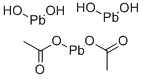
| LEAD SUBACETATE Basic information |
| LEAD SUBACETATE Chemical Properties |
| Melting point | 75℃ | | form | Granular Powder | | color | White | | Water Solubility | Soluble in water. | | Sensitive | Air Sensitive | | Merck | 14,5419 | | Exposure limits | NIOSH: IDLH 100 mg/m3; TWA 0.050 mg/m3 | | Stability: | Stable, but may be air-sensitive. | | EPA Substance Registry System | Lead acetate (1335-32-6) |
| LEAD SUBACETATE Usage And Synthesis |
| Chemical Properties | dense white powder | | Chemical Properties | Lead subacetate is a white, heavy powder or
gelatinous solid. | | Uses | In sugar analysis to remove coloring matters, etc., from solutions before polarizing; for clarifying and decolorizing other solutions of organic substances. | | Uses | Lead(II) acetate is used in the production of sweeteners, cosmetics, astringent, used in the cleaning and maintenance of stainless steel firearm suppressors (silencers) and compensators, and also used in making of slow matches. | | General Description | White dense powder . | | Air & Water Reactions | Keep container well closed. | | Reactivity Profile | Acidic organic/inorganic salts, such as LEAD SUBACETATE, are generally soluble in water. The resulting solutions contain moderate concentrations of hydrogen ions and have pH's of less than 7.0. They react as acids to neutralize bases. These neutralizations generate heat, but less or far less than is generated by neutralization of inorganic acids, inorganic oxoacids, and carboxylic acid. They usually do not react as either oxidizing agents or reducing agents but such behavior is not impossible. Many of these compounds catalyze organic reactions. | | Potential Exposure | Used as a decolorizing agent in sugar
solutions and as an analytical chemical. | | Shipping | UN1616 Lead acetate, Hazard Class: 6.1;
Labels: 6.1-Poison Inhalation Hazard | | Incompatibilities | Incompatible with oxidizers (chlorates,
nitrates, peroxides, permanganates, perchlorates, chlorine,
bromine, fluorine, etc.); contact may cause fires or explosions. Keep away from alkaline materials, strong bases,
strong acids, oxoacids, and epoxides. | | Waste Disposal | Consult with environmental
regulatory agencies for guidance on acceptable disposal
practices. Generators of waste containing this contaminant
(≥100 kg/mo) must conform with EPA regulations governing storage, transportation, treatment, and waste disposal |
| LEAD SUBACETATE Preparation Products And Raw materials |
|

 日本语
日本语 한국어
한국어 Français
 Deutsch
 España
 Türkiye