Other grades of this product :
| Tazobactam acid Basic information |
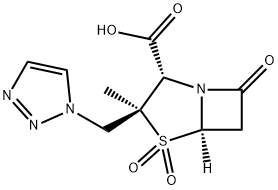
| Product Name: | Tazobactam acid | | Synonyms: | 4,4-dioxide,(2s-(2-alpha,3-beta,5-alpha))--triazol-1-ylmethyl);cl298741;ytr83oh;TAZOBACTAM;tazobactam acid;TAZOBACTAN ACID;(2S,3S,5R)-3-METHYL-4,4,7-TRIOXO-3-[1,2,3]TRIAZOL-1-YLMETHYL-4LAMBDA6-THIA-1-AZA-BICYCLO[3.2.0]HEPTANE-2-CARBOXYLIC ACID;Tazobactam, Free acid | | CAS: | 89786-04-9 | | MF: | C10H12N4O5S | | MW: | 300.29 | | EINECS: | 618-303-7 | | Product Categories: | TAZOCIN;Amino Acid Derivatives;Peptide Synthesis/Antibiotics;pharmaceutical | | Mol File: | 89786-04-9.mol |
| Tazobactam acid Chemical Properties |
| Melting point | 115-145℃ | | Boiling point | 77℃ | | density | 1.92±0.1 g/cm3(Predicted) | | RTECS | XI0191400 | | Fp | >110°(230°F) | | storage temp. | Sealed in dry,Store in freezer, under -20°C | | solubility | DMSO (Slightly, Heated), Methanol (Slightly, Heated, Sonicated) | | form | neat | | pka | 2.33±0.40(Predicted) | | color | White to Off-White | | Water Solubility | Soluble in water | | Stability: | Light Sensitive | | CAS DataBase Reference | 89786-04-9(CAS DataBase Reference) |
| Hazard Codes | Xi | | Risk Statements | 36/37/38 | | Safety Statements | 26-36 | | WGK Germany | 3 | | HS Code | 2941106000 |
| Tazobactam acid Usage And Synthesis |
| Description | Tazobactam often is coadministered with piperacillin because of tazobactam's ability to inhibit β-lactamases.
T azobactam, like other β-lactamase inhibitors, has little or no antibacterial activity. This effect is analogous
to that of clavulanic acid and sulbactam. | | Chemical Properties | White or off-white powder | | Originator | CL-307579,China Pharm Chemical Co.,,China | | Uses | b-lactamase inhibitor | | Uses | Tazobactam is a β-Lactamase inhibitor, used with β-lactam antibiotics to enhance their effect. | | Definition | ChEBI: A member of the class of penicillanic acids that is sulbactam in which one of the exocyclic methyl hydrogens is replaced by a 1,2,3-triazol-1-yl group; used (in the form of its sodium salt) in combination with ceftolozane sulfate for treatment of complicat
d intra-abdominal infections and complicated urinary tract infections. | | Manufacturing Process | A known β-lactam type antibiotic (for example, benzhydryl 2-β-chloromethyl-
2-α-methylpenam-3-α-carboxylate) was used for synthesis of new penicillinic
derivatives.A solution of 5.00 g of sodium azide in 53 ml of water was added to a solution
of benzhydryl 2-β-chloromethyl-2-α-methylpenam-3-α-carboxylate (5.13 g) in
dimethylformamide (155 ml). The mixture was stirred at room temperature
for 4 h. The resulting reaction mixture was poured into cooled water and the
mixture was extracted with ethyl acetate. The ethyl acetate layer was washed
with water, dried over magnesium sulfate and concentrated to provide 4.87 g
of the benzhydryl 2-β-azidomethyl-2-α-methylpenam-3-α-carboxylate as oil in
93% yield.To a solution of benzhydryl 2-β-azidomethyl-2-α-methylpenam-3-α-
carboxylate (7.03 g) in a mixture of acetic acid (240 ml) and water (40 ml)
was added potassium permanganate (6.02 g) over a period of more than 1 h.
The mixture was stirred at room temperature for 2.5 h. The resulting reaction
mixture was diluted with ice water. The precipitate was collected by filtration,
and washed with water. The resulting product was dissolved in ethyl acetate
and the solution was washed with an aqueous solution of sodium hydrogen
carbonate and dried over magnesium sulfate. Concentration gave 5.48 g of
the benzhydryl 2-β-azidomethyl-2-α-methylpenam-3-α-carboxylate-1,1-dioxide
in 72% yield.A 200 mg quantity of benzhydryl 2-β-azidomethyl-2-α-methylpenam-3-α-
carboxylate-1,1-dioxide was reacted with 10 ml of vinyl acetate in a sealed reactor at 100° to 110°C for 30 h. The reaction mixture was concentrated at
reduced pressure. The residue was crystallized with cooled chloroform. The
white crystals of benzhydryl 2-α-methyl-2-β-(1,2,3-triazol-1-yl)methylpenam-
3-α-carboxylate-1,1-dioxide have a melting point 206°-208°C, dec.Hydrogenation was conducted in 10 ml of ethyl acetate and 10 ml of water at
room temperature for 30 min by using 45 mg of benzhydryl 2-α-methyl-2-β-
(1,2,3-triazol-1-yl)methylpenam-3-α-carboxylate-1,1-dioxide, 15 mg of 10%
palladium charcoal and 16 mg of sodium hydrogen carbonate. The aqueous
layer was separated from the reaction mixture and washed once with ethyl
acetate. The aqueous solution was then purified with an MCl gel, CHP-20P
(product of Mitsubishi Kasei Co., Ltd., Japan). After freeze-drying, there was
obtained an amorphous product of sodium 2-α-methyl-2-β-(1,2,3-triazol-1-
yl)methylpenam-3-α-carboxylate-1,1-dioxide with a melting point 170°C, dec. | | Therapeutic Function | Antibiotic | | Antimicrobial activity | Tazobactam exhibits little useful antimicrobial activity,
although weak activity against Acinetobacter spp. and Borrelia
burgdorferi has been reported. | | Clinical Use | Tazobactam is a penicillanic acid sulfone that is similar instructure to sulbactam. It is a more potent β-lactamaseinhibitor than sulbactam and has a slightly broader spectrumof activity than clavulanic acid. It has very weak antibacterialactivity. Tazobactam is available in fixed-dose, injectablecombinations with piperacillin, a broad-spectrum penicillinconsisting of an 8:1 ratio of piperacillin sodium to tazobactamsodium by weight and marketed under the trade name Zosyn.The pharmacokinetics of the two drugs are very similar. Bothhave short half-lives (t1/2 ~1 hour), are minimally proteinbound, experience very little metabolism, and are excreted inactive forms in the urine in high concentrations.Approved indications for the piperacillin–tazobactamcombination include the treatment of appendicitis, postpartumendometritis, and pelvic inflammatory disease caused byβ-lactamase–producing E. coli and Bacteroides spp., skin andskin structure infections caused by β-lactamase–producingS. aureus, and pneumonia caused by β-lactamase–producingstrains of H. influenzae. | | Veterinary Drugs and Treatments | Although veterinary experience is limited with piperacillin or piperacillin/
tazobactam, these drugs have expanded coverage against
many bacteria and may be suitable for empiric use until culture and
susceptibility data are available, or for surgical prophylaxis when
gram-negative or mixed aerobic/anaerobic infections are concerns. | | Drug interactions | Potentially hazardous interactions with other drugs
Reduced excretion of methotrexate - monitor
methotrexate levels during concomitant treatment.
Enhanced action of vecuronium and similar
neuromuscular blocking agents. | | Metabolism | Piperacillin is metabolised to a minor microbiologically
active desethyl metabolite. Tazobactam is metabolised
to a single metabolite that has been found to be
microbiologically inactive.
Piperacillin and tazobactam are eliminated via the
kidney by glomerular filtration and tubular secretion.
Piperacillin, tazobactam, and desethyl piperacillin are also
secreted into the bile. |
| Tazobactam acid Preparation Products And Raw materials |
|


 日本语
日本语 한국어
한국어 Français
 Deutsch
 España
 Türkiye